Guide on Database as a Service: When to Use DBaaS vs Self-Hosted
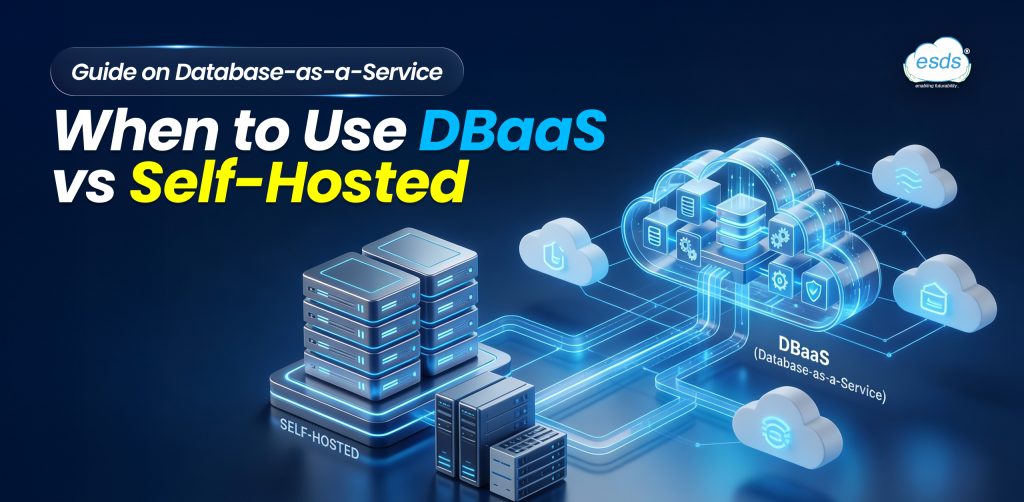
Databases sit at the center of enterprise applications, analytics platforms, and digital services. As data volumes increase and availability expectations rise, managing databases has become an operational challenge rather than a purely technical one. This has led many organizations to evaluate Database-as-a-Service (DBaaS) as an alternative to traditional self-hosted database models.
According to Grand View Research, the global cloud database and Database-as-a-Service (DBaaS) market was estimated at USD 19.95 billion in 2024 and is projected to reach USD 49.78 billion by 2030. This growth is attributed to the broader adoption of cloud computing models as organisations seek flexible and cost-efficient approaches to database management.
This guide explains what DBaaS is, how it works, its core features, security considerations, and how to decide between DBaaS and self-hosted databases.
What Is Database-as-a-Service (DBaaS)?
Database-as-a-Service is a managed service model in which database infrastructure and routine operational tasks are handled by a service provider. Instead of deploying and maintaining databases on dedicated servers or virtual machines, organisations consume databases as a managed platform.
DBaaS typically supports relational and non-relational databases and allows teams to focus on application logic and data usage rather than infrastructure management. While database access remains with the customer, responsibilities such as patching, backups, monitoring, and high availability are managed as part of the service.
How DBaaS Works
In a DBaaS environment, database instances are provisioned through a service interface based on defined parameters such as database type, storage, performance requirements, and availability settings.
Once deployed:
- Infrastructure resources are abstracted from the user
- Operational tasks are automated and centrally managed
- Monitoring and alerts are continuously active
- Scaling actions follow defined policies or service requests
The customer retains control over schema design, queries, data access, and application integration, while the service provider manages the underlying database operations.
Core Features of Database-as-a-Service
1. Automated Provisioning
Databases can be created or modified without manual infrastructure configuration, reducing deployment time and dependency on specialised skills.
2. High Availability and Replication
DBaaS platforms commonly include built-in replication and failover mechanisms designed to support application continuity.
3. Backup and Recovery
Scheduled backups and recovery workflows are managed as part of the service, reducing the risk associated with manual processes.
4. Monitoring and Performance Management
Continuous monitoring helps identify performance issues, capacity constraints, and operational anomalies.
5. Scalability Controls
Compute and storage resources can be adjusted based on workload needs, subject to defined policies and approvals.
6. Access Management
Role-based access controls and audit logs support governance and accountability requirements.
Benefits of Using DBaaS
- Reduced Operational Overhead
Routine database management tasks are handled by the service, allowing internal teams to focus on development and analytics.
- Faster Deployment Cycles
Standardised provisioning accelerates application development and testing workflows.
- Consistent Operations
DBaaS enforces uniform operational practices across environments, reducing configuration drift.
- Alignment with Modern Application Architectures
DBaaS integrates well with DevOps pipelines, containerised applications, and hybrid cloud environments.
- Predictable Management Effort
Operational responsibilities are defined upfront, reducing uncertainty in ongoing database maintenance.
Security and Compliance Considerations in DBaaS
Security in DBaaS follows a shared responsibility model. While the service provider manages infrastructure-level security controls, customers remain responsible for data access policies, application security, and compliance with applicable regulations.
Key security aspects include:
- Encryption of data at rest and in transit
- Controlled administrative access
- Audit logging and activity monitoring
- Data residency controls based on deployment location
For regulated sectors, DBaaS adoption must align with data residency, audit readiness, and governance models, similar to broader sovereign infrastructure design considerations discussed in enterprise cloud & AI deployments.
When to Use DBaaS vs Self-Hosted Databases
DBaaS is typically suitable when:
- Operational efficiency is a priority
- Applications require predictable availability
- Internal teams prefer managed operations
- Standard database configurations meet workload needs
Self-hosted databases may be preferred when:
- Extensive customisation is required
- Workloads demand specialised tuning
- Full infrastructure-level control is necessary
- Legacy dependencies limit platform flexibility
The decision between DBaaS & self-hosted databases is often influenced by broader private users public cloud compliance considerations, particularly for organisations operating under Indian regulatory frameworks.
A Complete Comparison Between DBaaS vs Self-Hosted Databases
Below is the completed caparison Between Database as a service vs self-hosted database.
| Aspect | DBaaS | Self-hosted |
| Infrastructure Management | Managed by service provider | Managed internally |
| Patching & Upgrades | Included in service | Manual or scripted |
| Availability & Failover | Platform managed | Requires custom design |
| Backup & Recovery | Automated | Team dependent |
| Scalability | Policy-driven | Capacity planning required |
| Compliance Responsibility | Shared | Primarily internal |
ESDS Database-as-a-Service: Governance, Availability, and Control
ESDS offers Database-as-a-Service as a managed platform designed to support enterprise and regulated workloads hosted within India-based infrastructure. The service focuses on operational management, availability, and governance while allowing customers to retain control over database usage and access.
Key characteristics include:
- Managed lifecycle operations covering provisioning, monitoring, and backups
- Support for commonly used database engines
- Deployment aligned with Indian data residency requirements
- Integration with broader managed services and cloud environments
- Defined access controls and operational visibility
ESDS DBaaS is positioned for organisations seeking managed database operations while maintaining alignment with regulatory, audit, and data localisation expectations.
Conclusion
Database-as-a-Service represents a shift in how organisations approach database operations moving from infrastructure ownership to service-oriented management. While DBaaS is not a universal replacement for self-hosted databases, it offers a structured option for organisations seeking operational consistency, managed availability, and reduced administrative effort.
Selecting the right database model depends on workload requirements, regulatory considerations, and internal operational maturity. As enterprises reassess how databases support business-critical applications, managed DBaaS platforms can play a defined role within modern IT environments when aligned with governance and risk frameworks.
Frequently Asked Questions (FAQs)
1. Is Database-as-a-Service suitable for enterprise workloads?
Yes. DBaaS is widely used for enterprise workloads that require consistent availability and managed operations. It is effective where database administration needs to be standardised without altering application behaviour.
2. Does DBaaS mean losing control over data?
No. Customers retain full control over data, schemas, queries, and access policies. The service provider manages infrastructure and routine operations, not data ownership or usage.
3. How is security handled in DBaaS?
DBaaS operates on a shared responsibility model where the provider manages platform security. Customers remain responsible for data access control, application security, and compliance alignment.
4. Can DBaaS support compliance and audit requirements?
Yes, when deployed with appropriate data residency, access controls, and audit logging. Organizations should assess hosting location, operational transparency, and documentation support.
5. How is DBaaS different from hosting a database on a virtual machine?
A virtual machine still requires manual database management by internal teams. DBaaS abstracts these tasks and delivers databases as a managed operational service.
6. When should an organisation choose self-hosted databases instead of DBaaS?
Self-hosted databases may be preferred for workloads needing deep customization or specialized tuning. Legacy dependencies and infrastructure-level control requirements can also drive this choice.


About Post Author