What is an AI Factory? – The Explainer Guide
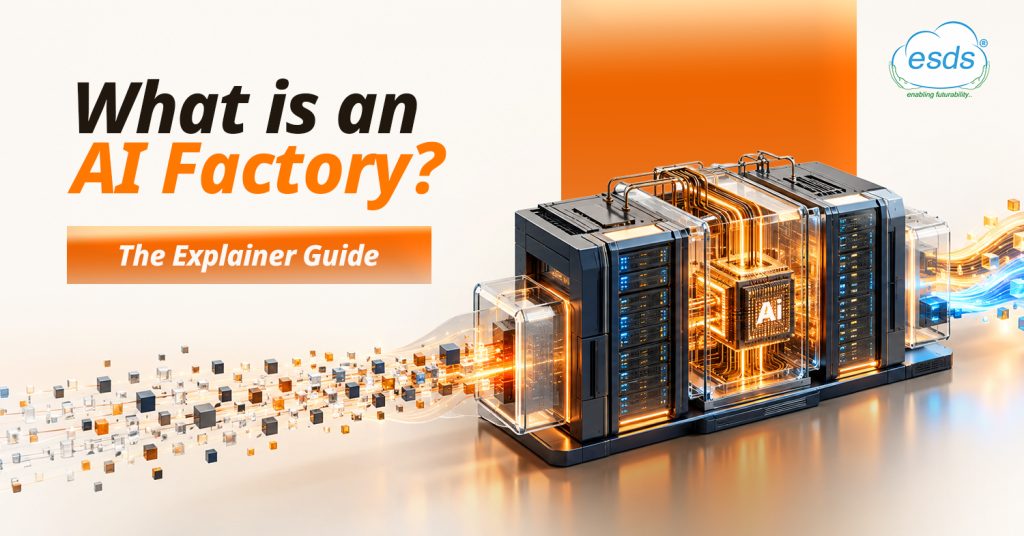
An AI factory is a purpose-built computing environment that turns raw data into intelligence at scale. It brings data pipelines, accelerated computer, networking, software and governance together so organisations can train, refine and run AI models as a repeatable process, not a string of one-off experiments.
Walk into almost any enterprise today and you will find AI pilots everywhere. A chatbot in customer service, a forecasting model in finance, a fraud detection proof of concept sitting on someone’s laptop. The ideas are good. The hard part is making them work every day, for every customer, without the costs or the risks spiralling.
The idea was first shaped by Harvard Business School professors Marco Iansiti and Karim R. Lakhani in their 2020 book Competing in the Age of AI, and later popularised by NVIDIA CEO Jensen Huang in his keynotes. Today, AI has moved out of the lab and into an industrial model, with data as the raw material and compute and MLOps pipelines turning it into models, applications and insights
That gap between a promising pilot and dependable production AI is exactly what an AI factory is designed to close. In this guide, we unpack what an AI factory is, how it works, what sits inside one, and why so many organisations are rethinking their infrastructure around the idea.
Why Is It Called an AI Factory?
Picture a traditional factory. Raw material comes in at one end, moves through a series of well-defined stations, and leaves as a finished product that meets a quality standard. Every batch follows the same process, and the line keeps getting better over time.
An AI factory works on the same logic. Data is the raw material. Training, fine-tuning, and testing are the assembly stations. The finished product is intelligence: predictions, answers, recommendations and decisions.
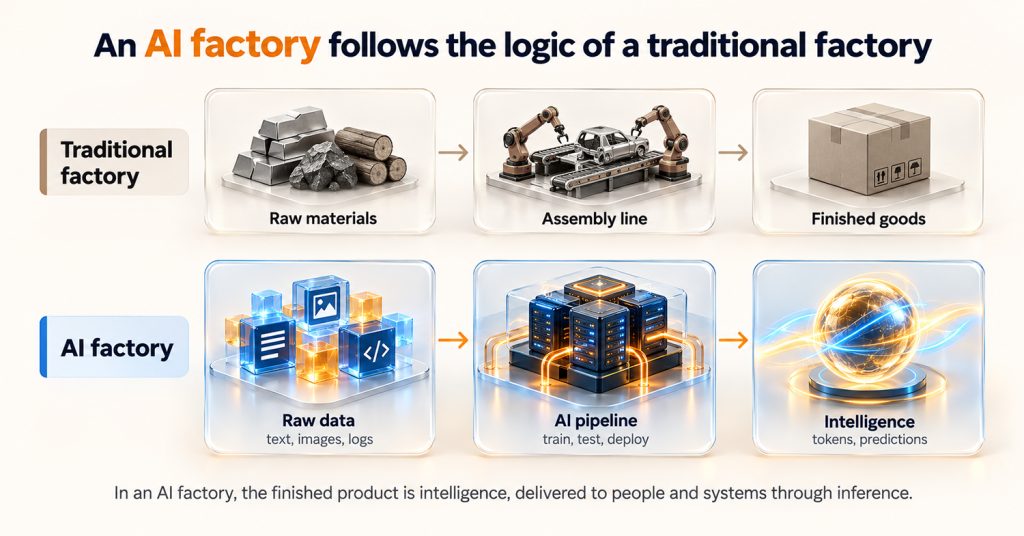
Many in the industry measure that output in tokens, the small units of text or data an AI model reads and generates. The more tokens a factory produces efficiently, the more intelligence it delivers back to the business.
How Does an AI Factory Work?
An AI factory runs a closed loop lifecycle. Every model in production sends lessons back into the next version, so the system keeps improving instead of going stale.
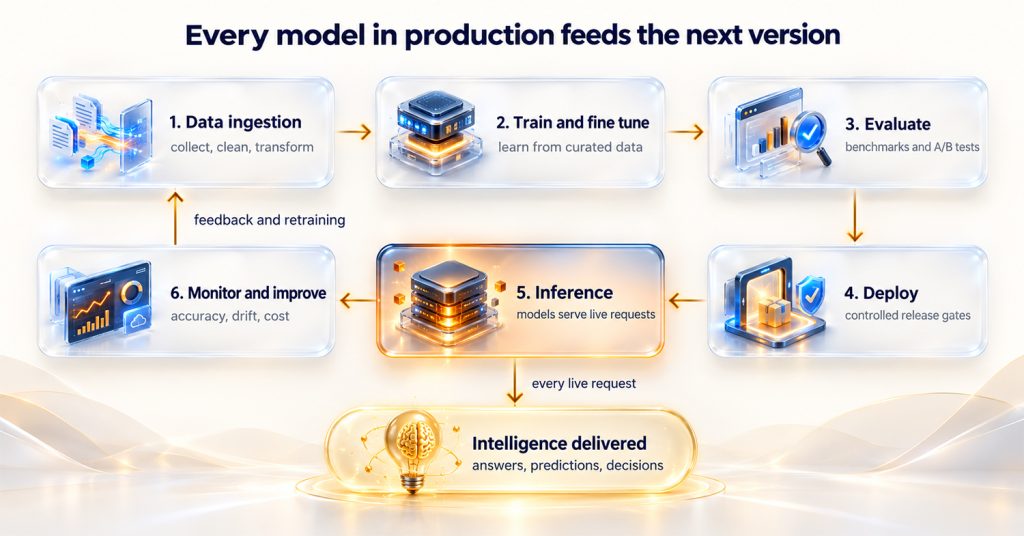
- Data ingestion and preparation. The data pipeline is the intake system. It collects, cleans, integrates and transforms raw data so only refined inputs reach the models. Automation keeps it flowing without constant human effort.
- Training and fine tuning. Models learn patterns from historical and synthetic data. Foundation models are fine tuned for a specific domain, such as banking language or medical records.
- Evaluation. Before anything goes live, models face offline benchmarks, A/B tests and simulations that check accuracy, fairness and robustness.
- Deployment. Approved models are packaged and released through controlled gates, with a safe way to roll back if something misbehaves.
- Inference. This is the production floor. The model answers real questions from real users and systems, often at high volume and low latency.
- Monitoring and improvement. Teams track accuracy, drift, response time, cost and user feedback. When performance slips or fresh data arrives, the loop starts again.
Components of AI Factory Architecture
Most AI factories are built in four layers, with security and governance running through every one of them.
- Compute and infrastructure. The foundation. High performance GPUs and specialised accelerators handle heavy training, while CPUs, fast interconnects, high throughput storage and advanced cooling keep everything running smoothly.
- Data layer. Where raw data becomes usable. Quality checks, versioned datasets, feature stores and vector databases for retrieval augmented generation all live here, along with lineage that shows where every data point came from.
- Tooling and automation. The factory’s control room. Orchestrated pipelines, experiment tracking, model registries and observability tools reduce manual effort and keep releases consistent.
- AI applications and services. What users actually see: assistants, copilots, fraud engines and recommendation systems.
- Security and governance. Access control, audit trails, encryption and compliance policies wrap around all four layers, so every model can be traced and trusted.
AI Factory vs Traditional Data Center: What Is the Difference?
A traditional data center provides general computing power. An AI factory is tuned for one job: producing AI outcomes continuously and reliably.
| Aspect | Traditional data center | AI factory |
| Primary purpose | Hosts general IT workloads | Produces intelligence at scale |
| Main output | Stored data and running applications | Predictions, answers and decisions |
| Compute | Mostly CPU based | GPUs and accelerators alongside CPUs |
| Workload pattern | Steady and predictable | Bursty training plus latency sensitive inference |
| Day-to-day operations | Server and application management | Model versioning, evaluation gates, drift monitoring |
| How success is measured | Uptime and capacity | Intelligence delivered, cost per outcome, reliability |
One point often gets missed: owning powerful hardware does not, by itself, make an AI factory. The difference lies in the processes, automation and governance layered on top of that hardware. For batch reporting or occasional small experiments, a traditional setup may be enough. When several teams are shipping AI into customer facing products, the factory approach starts to matter.
What Are the Benefits of an AI Factory?
The biggest benefit is simple: AI stops being a science project and starts behaving like a dependable business service.
- Faster path to production. Automated pipelines and standard release gates shorten the journey from prototype to live service.
- Reuse across teams. Shared datasets, features, models and templates mean one team’s work can power another team’s product.
- Better cost control. Pooled compute, smarter training schedules and right sized inference capacity help keep spending in check.
- Room to scale. Elastic infrastructure supports more teams and more use cases without rebuilding from scratch each time.
- Governance built in. Privacy, security and audit controls are part of the process, not an afterthought, which builds trust with regulators and customers.
- Continuous improvement. Monitoring and retraining keep models accurate as the world around them changes.
Where Are AI Factories Used Today?
Almost any industry that runs on data can put an AI factory to work. A few stand out.
- Banking and financial services. Fraud detection models that respond in real time, backed by strict lineage and approval workflows that auditors can follow.
- Healthcare and life sciences. Analysing large datasets to find promising drug candidates, tailoring treatment plans, and powering clinical assistants on privacy protected data.
- Manufacturing. Predictive maintenance built on sensor data, with models managed centrally and running at the edge on the factory floor.
- Retail. Personalised recommendations and demand forecasting that improve every time new purchase data arrives.
- Telecommunications. Network optimisation and smarter customer service using large language models.
- Automotive and robotics. Training and continuously refining the AI behind autonomous systems.
Take a retailer as a simple example. Purchase history flows in, a recommendation model is trained and tested, then deployed to the website. Click rates, response times and drift are tracked, and the model is retrained whenever performance dips. That repeatable cycle is the AI factory in action.
How Can You Deploy an AI Factory, and What Should You Watch For?
There is no single right model. The best fit depends on your data, your regulators and your existing IT investments.
- On premises. Full control over data location, security and performance. Often preferred in banking, government and other regulated sectors where data residency matters.
- Cloud. Quick to scale and flexible, which suits fast experimentation and workloads that rise and fall.
- Hybrid. A blend of both. Sensitive training stays in house while elastic cloud capacity absorbs peaks, all under one set of controls.
Whichever route you choose, plan early for the common hurdles:
- Data readiness. Incomplete or biased data quietly undermines every model built on it.
- Cost and complexity. GPUs, storage and tooling add up quickly, so standardise tools and avoid sprawl.
- Security and compliance. Sensitive data and models need encryption, access rules and clear audit trails.
- People and ownership. Clear roles across data, engineering, security and business teams matter as much as the hardware.
Bottom Line
An AI factory is less about any single piece of hardware and more about a way of working. It brings data, compute, tools and governance into one repeatable system that keeps producing intelligence, and keeps getting better at it.
For organisations stuck in the pilot phase, that shift is the real opportunity. The question is no longer whether AI can help your business. It is whether you have the factory in place to deliver it reliably, securely and at scale.
Frequently Asked Questions About AI Factories
What is an AI factory?
A purpose-built computing environment that turns raw data into intelligence at scale.
Why is it called a factory?
Just as a factory turns raw material into finished goods, an AI factory turns data into answers, predictions and decisions.
What does an AI factory produce?
Intelligence, often measured in tokens, the units of text or data that AI models read and generate.
How does an AI factory work?
It runs a closed loop of data ingestion, training, evaluation, deployment, inference and monitoring.
What are the core components of an AI factory?
Compute and infrastructure, a data layer, tooling and automation, and AI applications, all wrapped in security and governance.
What hardware powers an AI factory?
High performance GPUs and accelerators, CPUs, fast networking, high throughput storage and advanced cooling
Is powerful hardware enough to build an AI factory?
No, it becomes a factory only when automation, repeatable processes and governance sit on top of it.
What are the key benefits of an AI factory?
A faster path to production, reuse across teams, better cost control, room to scale and governance built in.
How is an AI factory different from a data center?
A data center runs general IT workloads, while an AI factory is optimised to produce AI outcomes continuously.

- What is an AI Factory? – The Explainer Guide - September 28, 2026
- AI-Powered SIEM Trends That Will Shape Security Operations in 2026 - September 22, 2026
- Why Enterprises Need AI-Driven Observability with SWARAJ Garuda and SWARAJ Jatayoo? - September 9, 2026