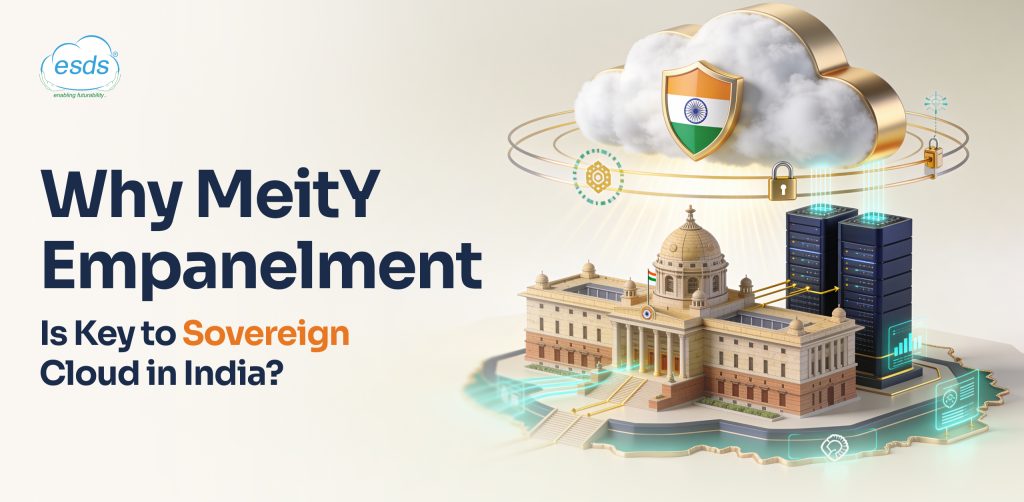
Why MeitY Empanelment Is Key to Sovereign Cloud in India?
India’s cloud market is shifting fast. Government agencies are digitising at scale. And one question now drives every procurement conversation: which cloud can we actually trust?
MeitY empanelment answers that question directly. It sets the compliance bar for secure government cloud providers in India. Understanding what it demands and how ESDS meets it helps agencies procure with confidence.
Here are seven reasons the framework matters for MeitY Empanelment from Sovereign Cloud.
1. Your Data Remains in India
Data localization is the first principle underpinning sovereign cloud India. MeitY empanelled providers host, process, and manage government data on Indian territory. This means there are no grey areas, no offshore server farms. This becomes crucial when dealing with citizen records, health care databases or even financial data. Data localisation is no longer a choice but a compliance requirement. ESDS maintains Tier III data centers in India in strict compliance with this requirement.
2. Third-Party Certifications Are Mandatory
Any cloud vendor may promise the world regarding security. A MeitY empanelled vendor offers proof by virtue of independent testing. The Standardisation Testing and Quality Certification (STQC) Directorate carries out independent tests of the infrastructure on various dimensions like security controls, access management, incident response, and service continuity.
This is of great significance from a procurement standpoint. The certification by STQC is from an external auditor and not the vendor who claims to have a good track record of security. This makes a huge difference while choosing the right government cloud.
3. The Framework Is Built for Government Workloads
Government cloud needs differ sharply from enterprise cloud needs. Agencies require multi-tenant data isolation, audit logging, role-based access, and integration with national platforms including Digi Locker, UMANG, and NIC systems. These cannot be retrofitted easily onto standard enterprise environments.
MeitY empanelment is designed around these requirements from the start. ESDS’s sovereign cloud India infrastructure supports these integration patterns natively, reducing deployment complexity and accelerating go-live timelines. For a deeper look at building compliant sovereign environments, this guide on Sovereign AI Infrastructure provides a deeper understanding of the key architectural considerations and implementation approaches.
4. SLAs Come with Real Accountability
Vague SLAs have long frustrated government cloud adoption. MeitY empanelment changes this. Providers must commit to standardised parameters, including uptime targets, support response windows, recovery time objectives, and defined escalation paths.
ESDS backs its empanelled services with documented uptime commitments, government-tier support desks, and clear RTO/RPO benchmarks. When a public health platform or a state citizen portal goes down, accountability cannot be optional. Empanelment ensures it is not.
5. Cross-Border Legal Risk Drops Significantly
The sovereign cloud India conversation has moved beyond privacy into national security territory. Foreign-headquartered providers operate under foreign legal jurisdictions. Their infrastructure can face cross-border data requests, export control restrictions, or service disruptions tied to geopolitical events.
Two related but distinct concepts underpin this risk: data sovereignty and data residency address different layers of the problem, and government buyers need to understand both clearly. ESDS is India-headquartered and India-operated, meaning its infrastructure is not subject to foreign government jurisdiction. That eliminates an entire category of legal exposure.
6. Procurement Becomes Faster and More Defensible
Government procurement is complex by design. Every vendor selection carries audit risk. The MeitY empanelment list removes a significant portion of that burden. It functions as a pre-vetted vendor registry, and providers on the list have already cleared baseline technical and compliance checks.
Agencies can select from empanelled providers without running full RFP cycles from scratch. Timelines shorten. Audit trails strengthen. And procurement teams have a defensible, policy-backed basis for every vendor decision. ESDS’s empanelled status makes it a lower-risk starting point for government cloud evaluation.
7. Alignment With India’s Digital Policy Direction Is Built In
India’s Digital Public Infrastructure agenda is growing across Account Aggregator, ONDC, and emerging data governance regulations. Each layer adds new compliance demands on cloud providers. MeitY empanelment is not a one-time badge; it requires continuous alignment with India’s evolving regulatory standards. For agencies making long-term infrastructure investments, this matters enormously. Empanelled providers must stay current, not catch up later. ESDS maintains its sovereign cloud India capabilities in step with India’s policy direction, making it a stable, future-aligned infrastructure choice. If your organisation is still weighing the urgency of this shift, this piece on why data sovereignty matters now puts the case plainly.
Bottom Line
MeitY empanelment addresses the core concerns that matter most in government cloud procurement: data localisation, independent auditing, workload-specific design, enforceable SLAs, legal risk reduction, procurement simplicity, and policy alignment. Empanelment status is one important indicator. But for agencies serious about secure govt cloud procurement in India, it is the right place to start. ESDS built its cloud infrastructure around these compliance requirements, not alongside them. That is the difference between a cloud that happens to be compliant and one that was designed to be.
Frequently Asked Questions
- Can foreign governments have access to data stored in India on a foreign cloud platform?
Data locality and data sovereignty are different concepts. Legislation like the U.S. CLOUD Act permits other nations to request data from companies in their jurisdiction, irrespective of where the actual data is hosted.
- Which Indian legislations require sovereign clouds to comply?
There are a number of legislative requirements mandating data localisation as well as jurisdiction over sensitive data. They include the DPDP Act, RBI circulars for financial data, as well as MeitY/NIC requirements for government workloads.
- Who manages encryption keys and access logs in a sovereign cloud?
In a true sovereign cloud environment, the encryption, access, and logging remain in-country and under the direct control of the organisation itself. ESDS makes sure that the encryption, access control, and auditing of data stay with the client, fully compliant with India’s legal requirements.
- What security capabilities does ESDS provide beyond basic cloud infrastructure?
ESDS operates a dedicated Security Operations Centre (SOC) with integrated SOAR capabilities.
Want to explore how ESDS’s MeitY-empanelled secure govt cloud fits your organisation’s requirements?
[Connect with our team for a consultation.]
- SWARAJ Sethu: Unified DevSecOps Platform from Code to Production - October 15, 2026
- Real-Time AI Monitoring for Better Model Performance - October 13, 2026
- Top Enterprise Use Cases for GPUaaS in AI & HPC - September 30, 2026