When Should You Use GPU-as-a-Service Instead of CPU Cloud?
Every infrastructure decision eventually comes down to one question: is this workload better suited to a CPU or a GPU? As AI, machine learning, and data-heavy applications become standard parts of business operations, that question directly affects your training time, inference costs, and ability to ship on schedule.
This guide breaks down exactly when GPU-as-a-Service (GPUaaS) makes more sense than traditional CPU cloud, and how to choose the right model for your workload.
What Is GPU-as-a-Service (GPUaaS)?
GPU-as-a-Service gives businesses on-demand access to GPU computing power without owning or maintaining the physical hardware. Instead of buying expensive GPU servers outright, you rent capacity on platforms equipped with NVIDIA or AMD GPUs, paying only for what you use.
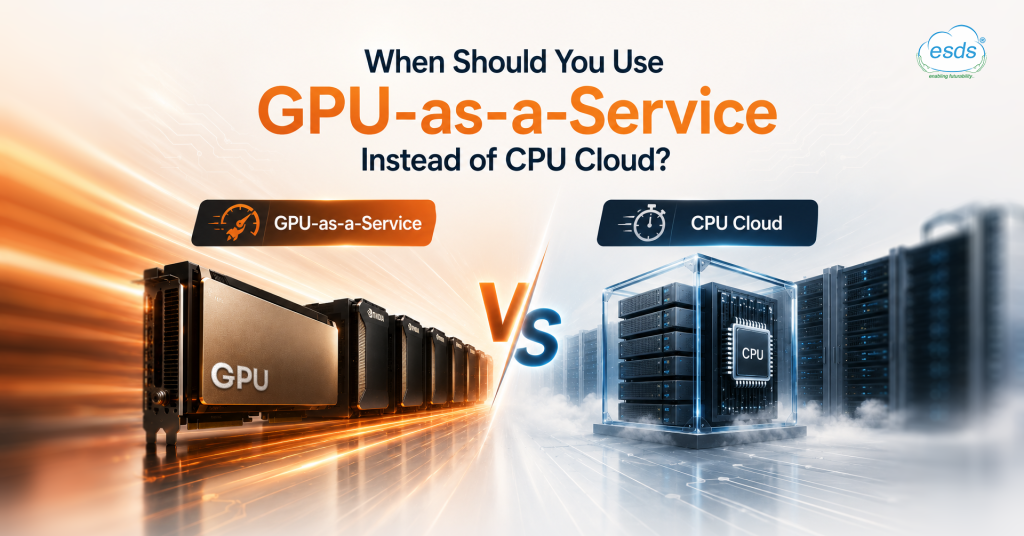
This is fundamentally different from CPU cloud, where general-purpose processors handle sequential tasks one at a time, very fast. GPUs are built for parallel processing: thousands of cores working simultaneously, making them dramatically faster for specific categories of work.
CPU Cloud vs GPU Cloud: The Core Difference
| Factor | CPU Cloud | GPU-as-a-Service |
| Processing style | Sequential, few powerful cores | Massively parallel, thousands of cores |
| Best for | Web apps, databases, business logic | AI/ML training, deep learning, simulations |
| Cost efficiency | Lower cost for light, general workloads | Better cost-per-task for parallel workloads |
| Typical use case | ERP, CRM, websites, microservices | LLM training, GenAI, computer vision |
When CPU Cloud Is Still the Right Choice
CPU cloud remains the most cost-effective option for hosting websites and APIs, running relational databases and transactional systems, general business applications (ERP, CRM, accounting), low-volume batch jobs, and any workload that isn’t parallelizable, where one step must finish before the next begins.
If your workload doesn’t involve large-scale matrix computations, model training, or massive unstructured datasets, a CPU instance is usually the more economical option.
When You Should Switch to GPU-as-a-Service
Here are the signals that it’s time to move to GPU cloud:
- You’re training or fine-tuning AI/ML models. Training a deep learning model or LLM involves billions of parallel matrix multiplications. On CPUs, this can take weeks; on modern GPUs with high-bandwidth memory and NVLink interconnects, the same job often compresses into a fraction of that time.
- You’re running GenAI or LLM inference at scale. Serving predictions to thousands of concurrent users, such as chatbots, copilots, and recommendation engines, needs low-latency, high-throughput inference, which CPU serving struggles to deliver under real traffic.
- You’re processing computer vision, video, or 3D workloads. Image recognition, video transcoding, and 3D rendering rely on parallel tensor and pixel operations that CPUs can’t match at volume.
- You’re running scientific or engineering simulations. Genomics, drug discovery, fluid dynamics, and risk modeling involve massive parallelizable calculations where GPU acceleration can meaningfully shorten run times.
- Your existing GPU utilization is low. Idle-owned hardware outside training cycles is a capital-efficiency problem. A managed GPU cloud model lets you right-size consumption instead of over-provisioning depreciating assets.
- You need to scale fast without capex. Buying and racking enterprise GPUs (NVIDIA B200/B300/H200 or AMD MI300X-class hardware) needs significant upfront capital, space, power, and cooling planning. GPUaaS removes that barrier entirely.
How ESDS GPU-as-a-Service Supports AI Infrastructure Decisions
ESDS GPU-as-a-Service is designed to help organizations move AI projects from pilot to production without taking on that complexity themselves.
- Latest-generation GPUs, on demand: Access to NVIDIA B200, B300, GB200, NVL72, H200, L40S, and AMD MI300X GPUs without the capex or lead time of buying hardware outright.
- Large-scale AI cluster architecture: GPU SuperPODs designed for high-bandwidth NVLink connectivity, large-scale distributed training, and high-throughput inference workloads.
- Flexible consumption models: GPU memory-based instances, dedicated GPU base configurations, or fully dedicated GPU appliances, matched to your actual workload.
- End-to-end: From GPU design consultancy to deployment, orchestration, and 24×7 monitoring, ESDS manages the operational layer so your team can focus on outcomes.
- India-based, compliance-ready: Built for enterprises and regulated sectors that need data residency alongside high-performance GPU compute.
Final Thoughts
CPU cloud and GPU-as-a-Service aren’t competing options; they’re complementary tools for different jobs. Use CPU cloud for the transactional backbone of your business, and bring in GPU-as-a-Service the moment your workload becomes parallel, data-heavy, or AI-driven. Getting this balance right is what lets technical teams scale AI initiatives without overspending on infrastructure that doesn’t match the workload.
If you’re evaluating whether your next AI initiative needs GPU acceleration, talk to an ESDS AI architect to scope the right configuration for your workload.

- Top Enterprise Use Cases for GPUaaS in AI & HPC - September 30, 2026
- What Is an AI Factory? Architecture, Benefits & Use Cases - September 28, 2026
- What Is Database Activity Monitoring (DAM) and How Does It Work? - July 31, 2026