GPU as a Service vs Buying GPUs Which Is Better for AI Projects in 2026
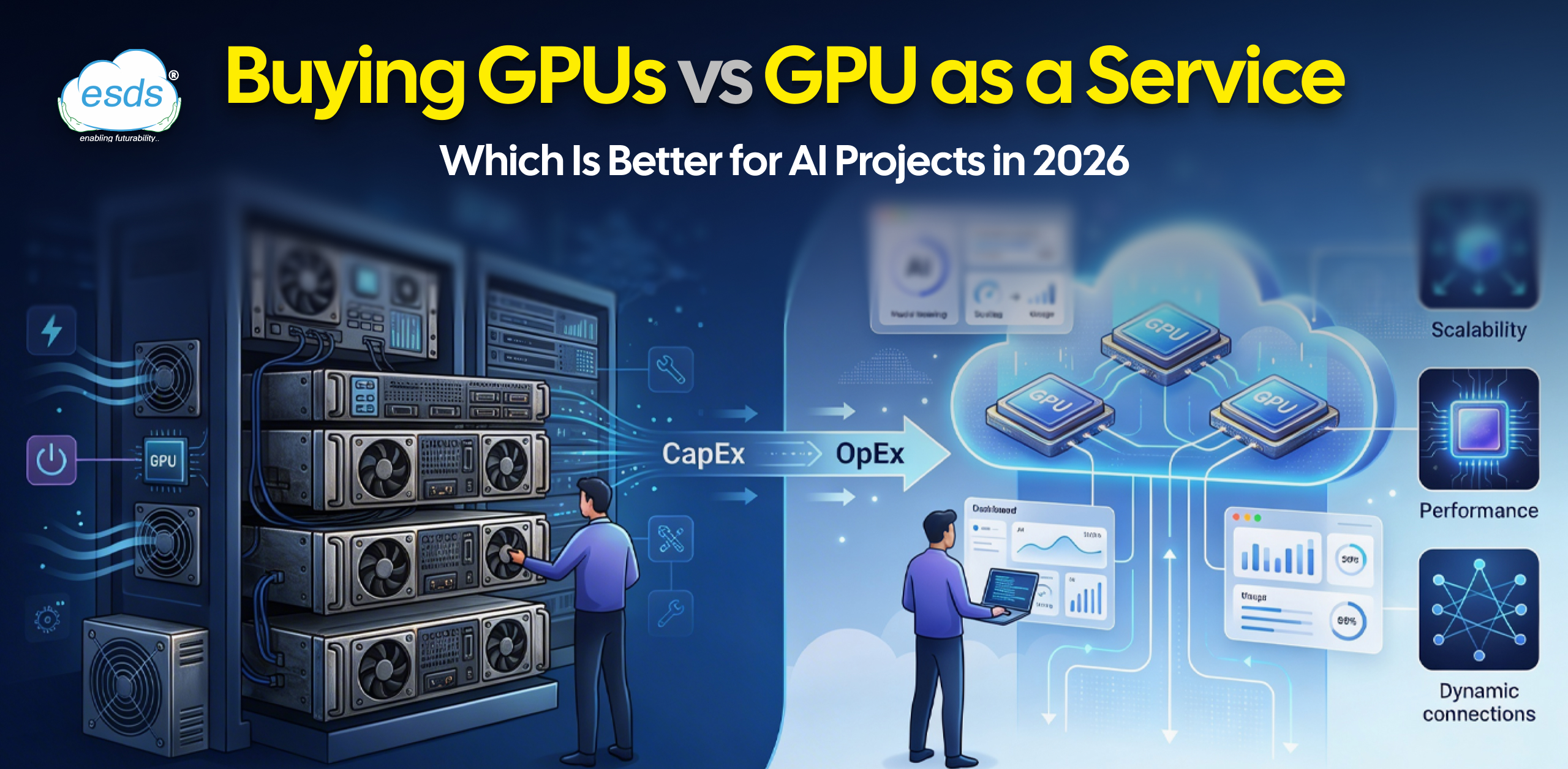
AI workloads are no longer experimental; they are entering production in various industries, quietly demanding more compute, more flexibility, and tighter control over costs. The real question being faced by many teams today is not how to scale AI, but how to build the right infrastructure to support it — whether that means investing in a dedicated GPU server or leveraging GPU as a Service in India. For organizations exploring GPU cloud hosting in India, the decision directly shapes AI infrastructure cost, scalability, and long-term agility.
At the heart of this decision is a practical trade-off: should organizations invest in a dedicated GPU server, or should they opt for GPU as a Service? The answer is not always obvious. It depends on patterns, financial plans, and the speed with which the AI roadmap is expected to change.
Let’s examine each option in terms of technical and financial considerations, particularly with respect to GPU cloud hosting in India and AI infrastructure cost in India.
The Case for Buying GPUs
Having a GPU server has always been viewed as a long-term investment, which allows users to have complete control over hardware, reliability, and customization.
Having dedicated GPU servers may make sense when running workloads like large-scale model training pipelines, which are stable and running all the time. There is no need to depend on any third-party vendors, and the data stays within the environment.
However, the cost model is quite different.
Having a high-performance GPU server means:
- Capital cost is high.
- Maintenance and cooling costs are high.
- There are power consumption issues.
- Hardware replacement is needed after 3 to 5 years.
When evaluated closely, the AI infrastructure cost in India for owning GPUs is not limited to procurement. Data center space, redundancy planning, and skilled personnel add layers of operational complexity.
There is also a utilization challenge. GPUs are often underutilized outside peak training cycles. Idle compute translates directly into sunk cost.
The Rise of GPU as a Service
GPU as a Service, as a concept, alters the way an organization thinks about compute. The organization does not need to buy infrastructure; instead, they will use GPU cloud hosting India.
This concept aligns with the real-world nature of AI projects, which are dynamic, iterative, and sometimes unpredictable.
With GPU as a Service, an organization in India will have the ability to:
- Spin up GPU instances as needed
- Scale up instances for training, scale down instances after completion
- Not have to buy hardware
- Have access to the latest GPU architectures without having to upgrade
For an organization that wants to try out different models, GPU as a Service for Indian enterprises will remove a lot of friction. The cost model will change from a capital expense model to an operating expense model. This is important when considering the cost of GPU infrastructure for AI projects in India
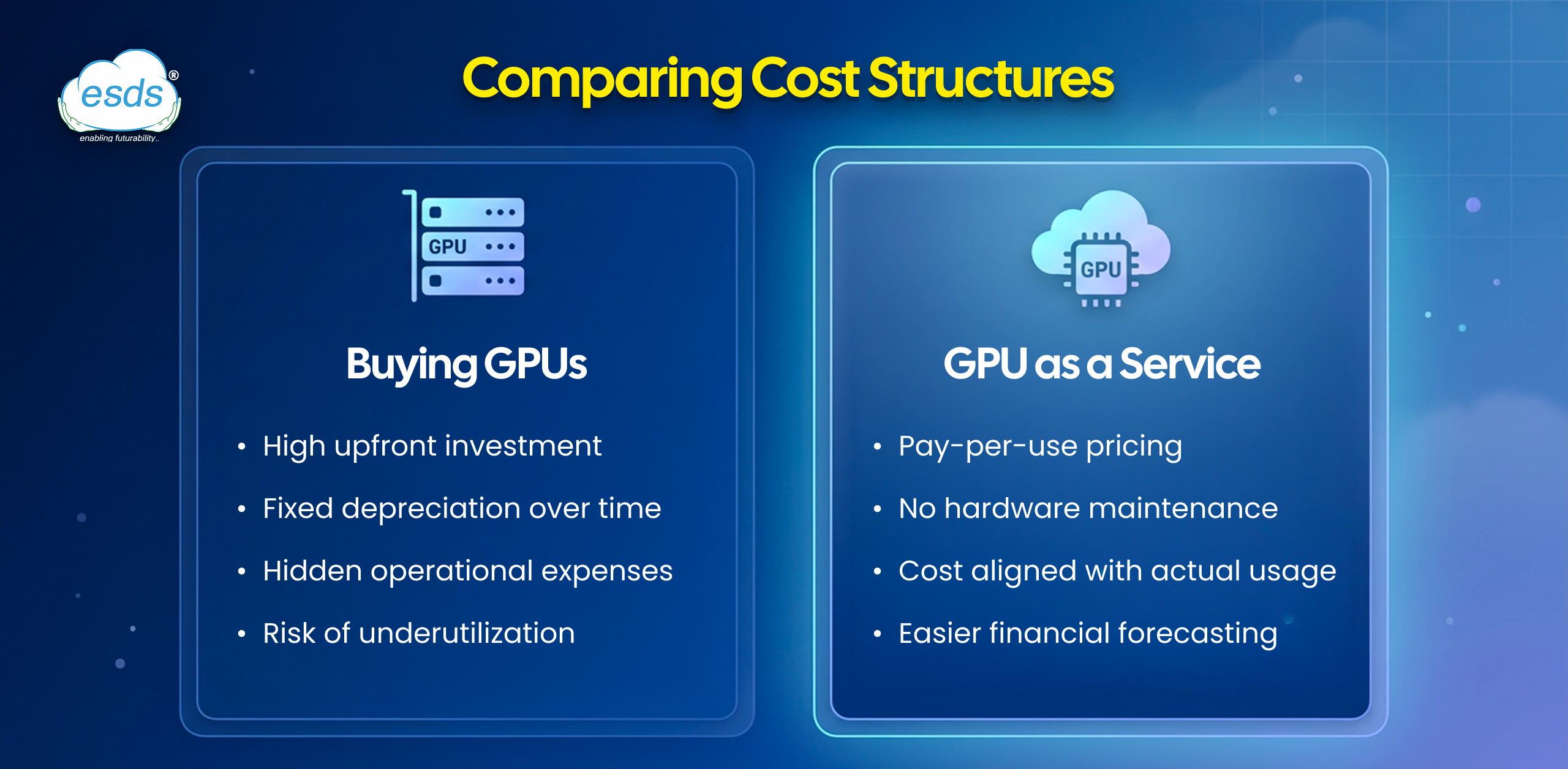
Comparing Cost Structures
Cost is usually the first criterion that comes into play while making any kind of decision. Therefore, it is essential to understand the context of cost.
Buying GPUs:
- High initial investment
- Depreciation of GPUs over a period of time
- Hidden costs of running GPUs
- Chances of underutilization of GPUs
GPU as a Service:
- No extra cost of using GPUs
- No maintenance of GPUs
- Cost directly proportional to the use of GPUs
- Easy forecasting of costs
In many cases, it’s more predictable to use a GPU cloud hosting solution in India. This helps organizations spread out the cost over a period of time rather than an initial investment. This becomes even more important when it comes to AI workload, which may be changing over time. It’s essential to not overcommit to a GPU server.
Performance and Scalability Considerations
While performance of a system or a task is not just about the computational power, it is also about the ease with which a team can scale up their access to computational power.
While a GPU server provides a consistent performance, scaling up a GPU server means additional procurement, setup, and integration.
GPU as a Service, on the other hand, allows for instant scalability, as multiple GPU instances can be created at the same time, thus enabling parallel experimentation.
For AI teams working on:
- Deep learning model training
- Computer vision pipelines
- Large language model fine-tuning
the ability to scale horizontally with GPU cloud hosting in India can help teams significantly.
Data Governance and Localization
For organizations in regulated environments, data residency is an important factor.
Having a GPU server gives an organization total control over data residency. However, with modern GPU as a Service for India, data residency is more in line with Indian regulatory needs.
With GPU cloud hosting in India, data can reside in India while at the same time benefiting from cloud scalability.
Operational Complexity
Running a GPU server is not just about installing hardware. It involves:
- Driver and firmware management
- Cluster orchestration
- Monitoring and optimization
- Security patching
These tasks require specialized expertise.
GPU as a Service abstracts much of this complexity. Managed environments allow teams to focus on model development rather than infrastructure maintenance.
For many organizations, reducing operational overhead is as important as managing AI infrastructure cost in India.
Flexibility in a Rapidly Changing AI Ecosystem
AI frameworks, model architectures, and compute requirements are evolving quickly. What is considered optimal today may not remain so in the next 12–18 months.
A GPU server purchased today may not support emerging workloads efficiently in the future.
GPU as a Service in India provides access to updated hardware without requiring reinvestment. This flexibility allows organizations to stay aligned with technological shifts without disrupting their infrastructure strategy.
When Buying GPUs Still Makes Sense
Despite the advantages of GPU as a Service, there are scenarios where owning a GPU server is justified:
- Continuous, high-volume workloads with predictable demand
- Strict internal policies requiring full infrastructure ownership
- Long-term cost optimization where utilization is consistently high
In such cases, the AI infrastructure cost in India may justify capital investment, provided utilization levels remain optimal.
When GPU as a Service Becomes the Better Choice
For most modern AI initiatives, there are practical advantages to using GPU as a Service. These are:
• Variable or experimental workloads
• Rapid scaling requirements
• Budget constraints tied to operational efficiency
• Faster deployment requirements
GPU cloud hosting services are available in India. This helps to meet the requirements of organizations without forcing them to commit to specific infrastructure options. The reality for many organizations, however, is that they are moving towards a hybrid solution. This means that while the core workload may be hosted on a dedicated GPU server, burst workload or experimental workloads are utilizing GPU as a Service for Indian businesses.
The choice between GPU as a Service and buying GPUs is not necessarily an either/or situation. Rather, it’s about understanding that the behavior of the workload will influence the best infrastructure solution. The reality of AI is that it’s not static. Therefore, the infrastructure should not be static either. For organizations that are struggling to understand this shift, GPU as a Service in India offers an alternative that allows organizations to be agile while maintaining control over costs and performance.
ESDS offers a GPU as a Service solution that’s designed to support AI workloads.