Data Sovereignty in India 2026: The Enterprise Playbook
TL;DR (Quick Summary): Data sovereignty means Indian courts/regulators govern the data and control its encryption keys – not just where it’s physically stored (that’s residency/localization, and even India-hosted data can be pulled by a foreign court under laws like the US CLOUD Act). Indian enterprises must map data across overlapping regulators (DPDP, RBI, SEBI, IRDAI, DoT, CERT-In) and classify it into 3 tiers -regulated (Aadhaar, PAN, payments), proprietary (IP, AI models), and operational (logs, public content) – to apply the right controls at the right cost.
Data Sovereignty is the principle that data is governed by the laws of the country that has legal jurisdiction over it, not simply by the country where the data is physically stored. Data Residency is about where data is kept. Data Localization mandates that some types of data stay in the country of origin. Data Sovereignty identifies which courts, regulators and government authorities can force access to data and who has control over encryption keys. For organizations in India, data sovereignty means making sure that their cloud systems follow the country’s rules and protect sensitive information. Compliance involves aligning with the DPDP Act, as well as sector-specific regulators like the RBI, SEBI, IRDAI, DoT, CERT-In and NCIIPC. Each of these authorities sets requirements for how data should be stored, processed and secured.
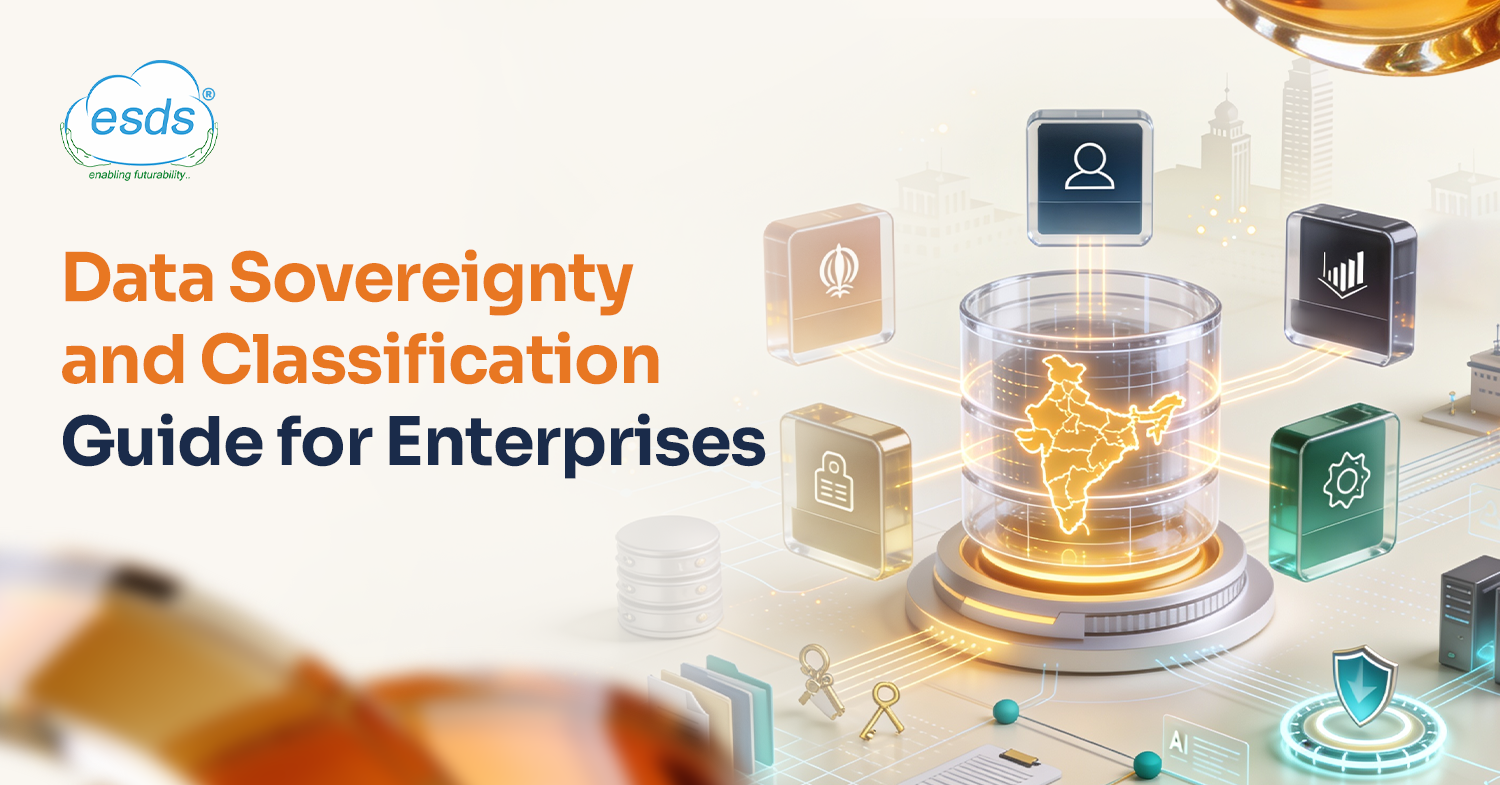
This is the first in a five-part blog series, titled, Data Sovereignty 2026: The Enterprise Playbook for India. It discusses the definition of data sovereignty in India, regulatory landscape to be navigated at an enterprise level, and a practical 3-tier enterprise data classification framework. The other four articles follow on this, as each architecture and compliance decision begin here.
1. Data Residency vs Data Localization vs Data Sovereignty
Data residency, data localization and data sovereignty each answer a different question. If they are used interchangeably, blind spots maybe created in architecture and compliance programs.
| Concept | What It Means | What It Ensures | What It Does Not Guarantee |
| Data Residency | Data physically sits within a country’s borders | Data does not leave the country at rest | Control over who can legally access or compel disclosure |
| Data Localization | A legal requirement to keep data within a country | Compliance with storage mandates from regulators such as RBI or DoT | Protection from foreign court orders or legal compulsion |
| Data Sovereignty | The country’s laws govern the data; the organization controls access and encryption | Only Indian courts and regulators can compel access; encryption keys remain under Indian control | Full sovereignty requires careful vendor selection and architecture, not just physical location |
A practical consideration: A cloud provider that is incorporated in the United States may have India-based data centers. There are high chances that such data centers would meet data residency requirements and data localization requirements for the information stored. But, according to the U.S. Clarifying Lawful Overseas Use of Data Act (CLOUD Act, 2018), a U.S. court, under specific legal conditions, may ask the provider to produce information that is stored on its servers located in India. If your organization is planning to use services of such providers, it is advised to consult with legal counsel before proceeding, to ensure compliances of Indian regulatory authorities.
Regulatory note (June 2026): This is an area where there is active interpretation of law. Check with your legal and compliance counsel before making your architecture decisions.
Also Read:– Why data sovereignty is important for Indian enterprises
2. India’s Compliance Framework
There is no single, all-industry data protection legislation in India. Indian enterprises have to adhere to various regulators, each with specific responsibilities. Such regulations often overlap.
| Regulator | Sector | Key Obligation | Primary Instrument |
| MeitY / DPDP | All (Personal Data) | Process personal data lawfully under DPDP Act; notify breaches; honour data principal rights | DPDP Act 2023; DPDP Rules 2025 |
| RBI | BFSI / Payments | Store all domestic payment system data in India; delete from foreign systems within 24 hours of processing abroad | RBI Circular RBI/2017-18/153 |
| SEBI | Capital Markets | Maintain records and audit trails in India; comply with CSCRF cybersecurity requirements | SEBI CSCRF Circular 2023 |
| IRDAI | Insurance | Store policyholder data and policy records within India; document conditions for cross-border sharing with reinsurers | IRDAI IT Guidelines |
| DoT | Telecom | Retain subscriber records, CDRs and network data in India; restrict unauthorized foreign remote access | DoT Unified License, Clause 39 |
| NCIIPC | Critical Infrastructure | Follow enhanced cybersecurity guidelines for power, defence, telecom, banking, transport and government systems | NCIIPC CII Guidelines |
| CERT-In | All Sectors | Report cyber incidents within six hours of discovery; retain cybersecurity logs for 180 days | CERT-In Directions, April 2022 |
| MeitY (GovCloud) | Government and PSUs | Use only MeitY-empanelled cloud service providers for government data and applications | MeitY Empanelment Guidelines |
How These Regulators Overlap
A bank that provides insurance products could be subject to requirements from RBI, IRDAI and DPDP at the same time with respect to the same dataset. A telecom operator providing payment services should meet the requirements of DoT, RBI and DPDP. All the sectors are covered under the reporting requirements of CERT-In. For enterprises with multiple verticals, each type of data needs to be matched up with each applicable regulator and then controls are designed to meet all of them.
3. Enterprise Data Classification Framework
Data classification is the highest-leverage step in a sovereignty program. Without it, organizations apply uniform controls across all data, which is both architecturally incorrect and commercially inefficient. A three-tier framework lets teams apply the right control at the right cost for each data category.
| Tier | Data Type | Examples | Localization Needed | Primary Risk |
| Tier 1 | Regulated high-risk personal and financial data | Aadhaar, PAN, health records, payment data, subscriber records, biometrics | Yes – sector regulations require India storage | Regulatory penalties (up to INR 250 crore under DPDP) |
| Tier 2 | High-value proprietary data without personal data content | Proprietary AI models, trade secrets, advanced analytics, R&D pipelines | No statutory mandate, but in-country storage is advisable | Commercial loss, IP theft, competitive damage |
| Tier 3 | Operational and public data | Server logs, system metadata, network telemetry, public marketing content | No requirement | Minimal direct regulatory or business risk |
Frequently Asked Questions
Does hosting data in an Indian data center make it sovereign?
Not necessarily. The physical location may meet the residency requirements as well as localization requirements. Sovereignty also relies on ownership of the data, jurisdiction of the courts that can force access and who holds the encryption keys. These are not only geographical questions; it is also about architecture and law.
Does the DPDP Act apply to foreign companies processing Indian citizens’ data?
The DPDP Act is written with extraterritorial application, covering organizations that process the personal data of Indian data principals regardless of where the processing occurs. Foreign companies serving Indian customers should review their obligations under the Act. We recommend consulting legal counsel for specific guidance.
What is the CLOUD Act and should enterprises be concerned?
The U.S. Clarifying Lawful Overseas Use of Data Act (2018) establishes a lawful basis for U.S. courts to order U.S.-incorporated cloud providers to provide data stored on their infrastructure anywhere in the world, under certain conditions. The impact in practice will depend on the corporate structure of the provider or the legal situation. For enterprises that need to store Tier 1 data, it is important to consult with legal counsel before considering the cloud.
Is data classification a one-time exercise?
No. Data flows change as products, APIs and business relationships evolve. Classification should be reviewed as needed, at least annually and when there is a significant change in architecture or after a business acquisition or after a new regulation.
How should organizations handle regulatory overlap between DPDP and sector laws like RBI or SEBI?
Where multiple regulators apply to the same dataset, organizations must satisfy the most stringent applicable requirement across all of them. Map each data element to every applicable regulator before designing controls and build architecture that satisfies all relevant obligations simultaneously.
References
- Digital Personal Data Protection Act, 2023 (Act No. 22 of 2023)
- DPDP Rules, 2025 (Notified January 2025, phased implementation)
- RBI Circular on Storage of Payment System Data, April 2018 (RBI/2017-18/153)
- SEBI Cybersecurity and Cyber Resilience Framework (CSCRF) Circular, 2023
- IRDAI IT Guidelines (applicable guidelines as updated)
- MeitY Cloud Services Empanelment Guidelines
- DoT Unified License Agreement, Clause 39
- U.S. Clarifying Lawful Overseas Use of Data (CLOUD) Act, 2018
- CERT-In Directions, April 2022
- NCIIPC Guidelines for Critical Information Infrastructure
- Ayushman Bharat Digital Mission (ABDM) Health Data Management Policy
Coming Up Next
The next piece, “Data Sovereignty 2026: Enterprise Architecture Principles,” builds on the classification framework and tackles the big question every cloud architect faces: how do you design infrastructure that keeps Tier 1 data truly sovereign? In it, we will walk through the six architecture pillars, explore encryption key models ranging from provider-managed KMS to HYOK with India-based HSMs, lay out the data lineage requirements and call out the silent architecture mistakes that can leave you exposed during audits.
Also Read:- Achieving secure reliable compliance with indias data sovereignty mandates

- Data Sovereignty in India 2026: The Enterprise Playbook - July 9, 2026
- The Rise of GPUs: The New Backbone of AI Development - March 2, 2026
- AI in India: A Silent Revolution with Big Impact - February 23, 2026