How AI Factories Are Redefining Data Centers for the AI Era?
TL;DR: AI factories are transforming traditional data centers into GPU-powered infrastructure designed for AI training, inference, and real-time intelligence. With advanced cooling, high-speed networking, and AI orchestration, they improve scalability, performance, and cost efficiency. ESDS supports this transformation through GPU-as-a-Service, SWARAJ Bodhi (AIOps), GPU Monitoring, SWARAJ Cloud, and integrated security solutions, enabling enterprises to accelerate AI adoption with flexible deployments, enhanced data security, compliance, and data sovereignty.
For three decades, the data center has had only one job; keep data safe, available and moving. That job still matters. But a new kind of facility is rising alongside it, and its output is not storage or uptime. Its output is intelligence.
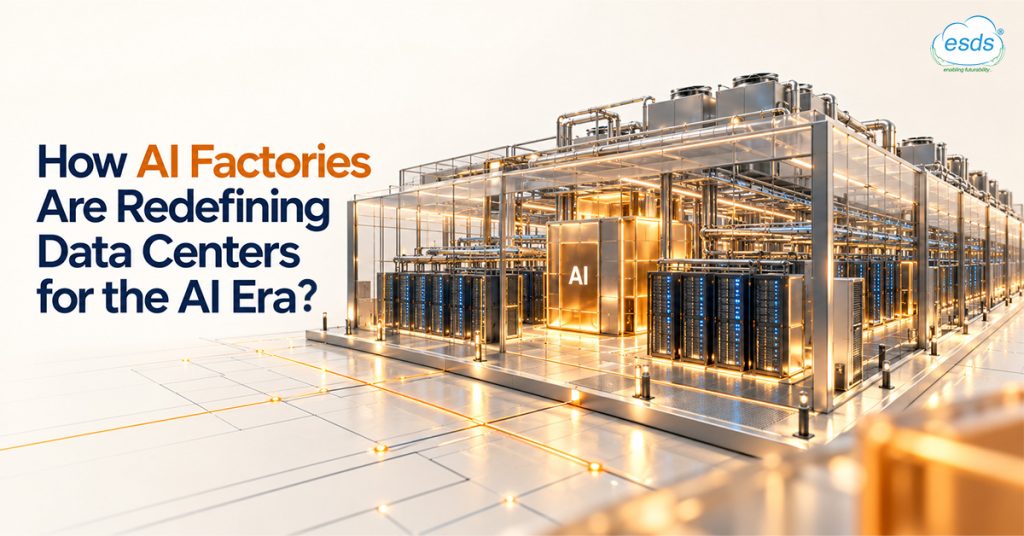
The industry calls it the AI factory. Data goes in; trained models, predictions, decisions and generated answers come out. As NVIDIA describes it, an AI factory does more than store and process data. It produces intelligence at scale. For enterprises, this is more than a hardware refresh. It changes how infrastructure is designed, powered, cooled, operated and measured. This blog explains what an AI factory is, how it is reshaping the data center, and what organizations should look for as they step into the next era of AI.
AI factory Vs Traditional Data Center
A traditional data center is a general-purpose facility. It hosts applications, databases, websites and storage for many different workloads. An AI factory is specialized: every layer, from silicon to software, is tuned to turn data into intelligence efficiently.
| Dimension | Traditional data center | AI factory |
| Primary purpose | Host and run general-purpose applications | Train, fine-tune and serve AI models |
| Core output | Storage, uptime, application availability | Tokens: predictions, decisions, generated content |
| Compute | CPU-led servers | GPU-accelerated clusters working as one system |
| Rack density | Moderate, largely air-cooled | Many times higher per rack |
| Cooling | Air cooling | Liquid cooling, often direct-to-chip |
| Networking | User-to-application traffic | High-bandwidth, low-latency GPU-to-GPU fabric |
| Software layer | Virtualization and hypervisors | GPU orchestration, MLOps and model serving |
| Key metric | Uptime and cost per rack | Token throughput, latency and cost per token |
Traditional data centers are not going away. Depending on the business model, an enterprise data center will either evolve into an AI factory or connect to one.
5 ways AI factories are redefining the data center
An AI factory is not simply a data center with GPUs added; it reshapes nearly every layer of the facility, from the rack to the balance sheet
- Compute moves from the server to the cluster
In a conventional facility, the server is the unit of compute. In an AI factory, the unit is the cluster. Hundreds or thousands of GPUs are linked to behave like one large accelerator, because modern models are too big for any single machine.
This changes procurement, capacity planning and floor layout. Enterprises now plan capacity in GPU pods and clusters, not individual servers.
- Power and cooling move to the center of design
AI hardware packs far more power into each rack than conventional servers do, and air cooling alone struggles to remove the heat. Liquid cooling, including direct-to-chip designs, is fast becoming the norm for dense GPU clusters.
Power availability is now a site-selection question, not an afterthought. Efficiency is judged by useful AI output per watt, not only by Power Usage Effectiveness (PUE).
- The network becomes the backbone
Training and serving large models mean constant data exchange between GPUs. High-bandwidth, low-latency fabrics, such as NVLink within a node and InfiniBand or AI-tuned Ethernet across nodes, keep every GPU fed with data.
The network is no longer plumbing. A slow fabric leaves the most expensive assets in the building waiting.
- Software orchestration decides utilization
GPUs are the costliest asset in an AI factory, so every idle hour matters. Orchestration software schedules jobs, partitions GPUs, serves models and tracks who used what capacity. Real-time observability of GPU health, temperature, power draw and utilization become a daily operating discipline, not a quarterly report.
- The business case shifts to cost per token
Traditional facilities are judged on uptime and cost per rack. AI factories are judged on how much intelligence they produce: token throughput, response latency and cost per token. Infrastructure stops being a cost center and starts behaving like a production line whose output can be measured and priced.
The stakes of downtime rise with it. NVIDIA estimates that every day of downtime at a gigawatt-scale AI factory can cost more than $100 million. Resilient design and proactive operations are no longer optional.
Why reasoning AI make AI factories necessary now?
For the last few years, the AI conversation centered on training ever-larger models. That is changing. With reasoning models and agentic AI, inference, the act of running a model to produce answers, has become the main driver of compute demand and of AI economics.
NVIDIA frames this through three scaling laws:
- Pretraining scaling: Bigger models trained on more data deliver predictable gains, but demand enormous compute and expertise. Once a foundation model exists, others can build on it.
- Post-training scaling: Enterprises fine-tune existing models for their own domain, language and data. Every adaptation adds to the cumulative demand for AI infrastructure.
- Test-time scaling: Reasoning and agentic models think before they answer, exploring several possible responses before choosing the best one. NVIDIA notes this can consume up to 100x more compute than traditional inference.
The implication is simple. Every AI agent that plans, every copilot that reasons and every vision system that runs in real time multiplies the inference load. Infrastructure built for occasional batch jobs cannot sustain always-on, high-volume inference. AI factories are designed for exactly that load.
This is also why governments and enterprises worldwide are investing in AI factories, increasingly treating them as core infrastructure on par with telecommunications and energy.
What enterprises should look for in an AI factory partner
Few enterprises will build a gigawatt-scale facility of their own. Most will consume AI factory capacity as a service, run GPU clusters in their own data center, or combine both. Whatever the model, these questions separate an AI-ready partner from a facility that has simply added GPUs.
| Capability | What to ask |
| AI-ready facilities | Can the site support high-density GPU racks, with the power and cooling they need? |
| Accelerated compute | Can capacity scale from a single GPU instance for experiments to multi-node clusters for large-scale training? |
| High-performance networking | Is the fabric designed for low-latency, GPU-to-GPU traffic at scale? |
| Orchestration and MLOps | Are GPU scheduling, ML pipelines and model serving part of the service, or left to your team? |
| Observability and cost control | Can you see GPU utilization, health and cost by team or project, in real time? |
| Security across the AI lifecycle | Are data, models and privileged access protected from ingestion to inference? |
| Compliance and data control | Do you decide where data and models reside, with controls aligned to applicable regulations such as India’s DPDP Act? |
| Flexible consumption | Can you move between on-demand, dedicated, private and hybrid models as needs change? |
How ESDS helps enterprises build their AI factory
What ESDS provides
• ESDS GPU-as-a-Service delivers large-scale GPU clusters and SuperPODs on current-generation NVIDIA and AMD GPUs, including NVIDIA L40S, H200, B200, B300 and GB200 NVL72, and AMD MI300X.
• SWARAJ Bodhi (AIOps): GPU fleet management, ML pipelines, distributed training, model serving, governance and GPU-hour cost tracking on one control plane.
• SWARAJ GPU Monitoring Tool: real-time GPU telemetry, temperature and power monitoring, AI-driven recommendations and multi-channel alerts.
• SWARAJ Cloud, the ESDS enterprise cloud platform integrating AI, security and compliance capabilities.
• SWARAJ Hansa (AI-agentic SIEM), SWARAJ Nandi (privileged access management), SWARAJ Jatayoo (database activity monitoring) and SWARAJ Garuda (unified observability).
Because ESDS designs, hosts, secures and operates these layers together, enterprises can start with a single GPU instance for experimentation and scale to dedicated clusters as their AI programs mature. Public, private and hybrid deployment models are designed to let each organization keep control of where its data and models reside.
Conclusion: The data center’s next chapter
The data center is not disappearing. It is being re-engineered around a new output. Organizations that treat AI infrastructure as a production line, measured in tokens, utilization and time to value, are better placed to move AI from pilots into everyday operations. The winners of the next era of AI will not be decided by who owns the most GPUs. They will be decided by who turns compute into intelligence most efficiently, securely and reliably. That is the work an AI factory is built to do.
Whether you need GPU capacity for your first model, a dedicated cluster for large-scale training or a managed environment for production inference, ESDS can help you design the AI factory that fits your business.
Talk to an AI infrastructure specialist
Frequently asked questions
How is an AI factory different from a traditional data center?
A traditional data center is general-purpose and CPU-led, built to host many kinds of workloads. An AI factory is GPU-accelerated, high-density and liquid-cooled, with a high-bandwidth network and software tuned to maximize token throughput.
Why is AI inference driving data center demand?
Reasoning and agentic AI models work through several steps before answering, which multiplies the compute needed per query. Because these applications run continuously, inference now drives most AI infrastructure demand.
What infrastructure does an AI factory need?
GPU compute, high-speed networking, high-density power and liquid cooling, AI-ready storage, orchestration and MLOps software, and continuous observability and security.
Do enterprises need to build their own AI factory?
Not necessarily. Enterprises can consume AI factory capacity through a GPU cloud, run dedicated GPU clusters on-premises or in a partner’s data center, or combine both in a hybrid model.
How does ESDS support AI factory deployments?
ESDS offers GPU-as-a-Service on GPU SuperPODs with on-demand, dedicated and hybrid consumption models, managed AI operations, real-time GPU monitoring and a security stack that spans the AI lifecycle.

- How AI Factories Are Redefining Data Centers for the AI Era? - October 26, 2026
- AI-Powered SIEM Trends That Will Shape Security Operations in 2026 - September 22, 2026
- Why Enterprises Need AI-Driven Observability with SWARAJ Garuda and SWARAJ Jatayoo? - September 9, 2026