How AI-Driven SIEM Reduces Alert Fatigue at Scale?
Every morning, security analysts across the world open their dashboards and face the same impossible task. Thousands of alerts. A handful of genuine threats are buried somewhere inside. And no reliable way to tell the difference quickly.
According to IBM’s Cost of a Data Breach Report, the average enterprise SOC receives over 10,000 security alerts per day. The 2024 Security Boulevard SOC Efficiency Study found that nearly one-third of SIEM alerts are false positives, with some organisations reporting rates as high as 80 percent. A separate 2023 study found that 83 percent of daily alerts turn out to be false alarms. The result is alert fatigue. This is the condition where sheer volume destroys vigilance, and real threats slip through not because analysts lack skill, but because they are exhausted by noise.
This is no longer just a workflow problem. It is a strategic business risk. When mean time to detect a breach exceeds 190 days, according to Ponemon Institute, the window for attackers grows dangerously wide. With the global cybersecurity talent gap at nearly four million professionals, organizations cannot simply hire their way out of the problem.
Why Traditional SIEM Platforms Are Making the Problem Worse?
Legacy SIEM platforms were built for a different era. Their primary goal was logging aggregation and compliance reporting, not intelligent threat detection. In today’s environments, they generate more noise than signal.
The pain points are consistent across organizations. Rule creation requires specialist knowledge and ongoing maintenance. Ingestion-based pricing penalizes comprehensive monitoring, forcing teams to choose between visibility and cost. Parser development for new data sources takes weeks, not hours. And manual investigation workflows mean analysts must assemble context from multiple tools before they can even begin to evaluate an alert.
Perhaps most damaging is vendor dependency. When even routine configuration changes require a support ticket, and onboarding a new client takes months, the operational model becomes unsustainable at scale.
How AI Changes the Equation?
Applied AI does not replace the security analyst. It removes the barriers that prevent skilled analysts from doing their best work.
An AI-powered SIEM evaluates every alert in context. It enriches each one with threat intelligence, correlates related events, and produces an explainable risk score before it reaches a human. Analysts no longer start from a blank page. They start from a structured assessment with recommended next steps already written.
The outcome is measurable: faster mean time to detect, faster mean time to respond, lower false positive rates, and critically, analysts who are able to focus on the incidents that genuinely require human judgment rather than spending their shift on mechanical triage.
Introducing Swaraj Hansa: a Sovereign SIEM platform
Swaraj Hansa (SIEM) is the AI-powered SIEM platform developed by ESDS. Its origin distinguishes it from the broader market: it was not built in a product organization by engineers imagining what analysts need. It was built inside a working security operations team at ESDS, by practitioners who had run every major SIEM platform on the market and identified exactly where each one fell short.
Every capability in the platform exists because a real analyst needed it. Every design decision reflects a real operational constraint. The result is a platform built on a simple premise: security operations should be getting simpler as tools mature, not more complex.
Swaraj Hansa vs Traditional SIEM Platforms
A capability-by-capability comparison that demonstrates how Swaraj Hansa outperforms traditional SIEM platforms
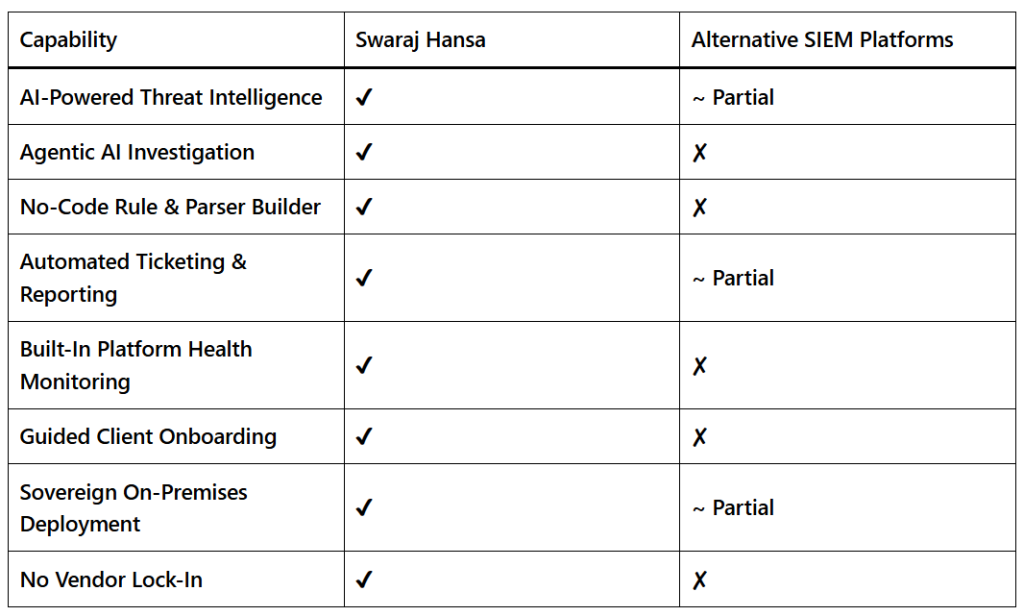
What Makes It Different: Swaraj Hansa compared to other SIEM platforms
- AI-Native by Design
AI-powered threat intelligence, intelligent correlation, & explainable security analysis built into every security event.
- Agentic Security Operations
Autonomous investigations, ticketing, reporting, and AI-assisted decision-making that reduce analyst workload.
- No-Code Detection Engineering
Visual rule creation & parser management accelerate deployment without vendor dependency.
- Sovereign Security Intelligence
On-premises deployment with ownership of security telemetry, ensuring digital sovereignty and compliance.
- Enterprise-Scale Architecture
Multi-tenant, highly available, self-monitoring architecture built to support modern hybrid & cloud environments.
Bottom Line
Alert fatigue is a solvable problem. It is not an inevitable feature of enterprise security operations. It is a symptom of tools that were never designed for the environments they are now expected to protect.
AI-powered SIEM does not eliminate the need for skilled analysts. It ensures that skilled analysts spend their time on work that only they can do: complex investigation, judgment calls, and strategic threat hunting. Not mechanical triage of alerts that a machine can evaluate faster and more consistently.
Swaraj Hansa (SIEM) was built on that principle. For security leaders evaluating whether their current SIEM is helping or hindering their team, it represents a direct answer to the question that matters most: how do we give our analysts back their time?
Frequently Asked Questions
- What is alert fatigue in cybersecurity?
Alert fatigue occurs when excessive security alerts overwhelm analysts, causing critical threats to be overlooked. - How does an AI-powered SIEM reduce false positives?
An AI-powered SIEM uses AI, threat intelligence, and behavioural analysis to prioritize genuine threats and reduce false positives. - What makes Swaraj Hansa different from traditional SIEM platforms?
Swaraj Hansa combines explainable AI, automation, and compliance-ready capabilities in a single, analyst-built SIEM platform. - Is Swaraj Hansa suitable for regulated industries in India?
Yes, Swaraj Hansa is built for India’s regulatory landscape with secure on-premises deployment and automated compliance reporting. - How quickly can Swaraj Hansa be deployed?
Swaraj Hansa enables rapid deployment through visual parser creation and simplified onboarding workflows. - Does AI in SIEM replace security analysts?
No, AI augments security analysts by automating repetitive tasks while leaving critical decision-making to humans.

- AI-Powered SIEM Trends That Will Shape Security Operations in 2026 - September 22, 2026
- Why Enterprises Need AI-Driven Observability with SWARAJ Garuda and SWARAJ Jatayoo? - September 9, 2026
- How AI-Driven SIEM Reduces Alert Fatigue at Scale? - July 28, 2026