What Is Database-as-a-Service (DBaaS) and How Does It Work?
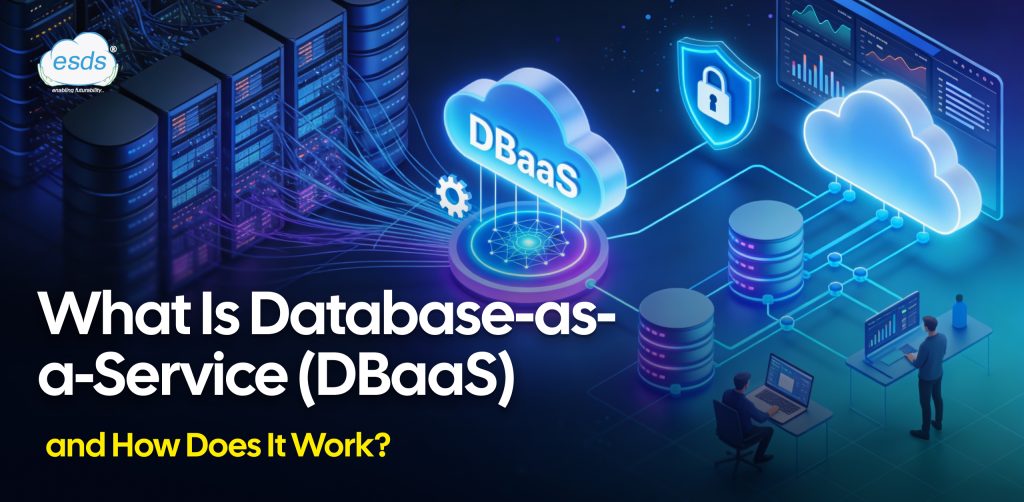
It is a known fact that data plays an important role in the operation of an IT organization. However, data is important for all kinds of businesses, be they small, medium, or large in size. Every organization creates huge amounts of data on a day-to-day basis, and the execution of different kinds of activities in the organization is based on the data created or collected. However, the maintenance of the data and the security of the data are the hardest tasks for a data-related organization.
To make the operation easier, new technology is introduced in the domain of the database on a day-to-day basis. One of the advanced technologies that makes the operation of the database easier is Database-as-a-Service.
In this blog, we are going to learn about DBaaS, the benefits of using DBaaS, and the significance of ESDS DBaaS.
What is Database-as-a-Service (DBaaS)?
We might think of DBaaS, or Managed Database Service, as a cloud computing service, similar to SaaS, PaaS, and IaaS. It makes it possible for people involved in database operations to access and utilize cloud database systems without having to buy them.
Database as a Service (DBaaS) is self-service/on-demand database consumption combined with automation of operations. DBaaS and cloud databases are under Software as a Service (SaaS), whose demand is rapidly increasing. Since cloud computing services are known to be pay-per-use, DBaaS is likewise predicated on the same payment model, where you just pay for the amount you use.
The functionality of this DBaaS is identical to that of conventional relational database models.
While adopting DBaaS simplifies operations, organizations must also carefully plan their transition strategy. Before migrating, it’s essential to evaluate key factors. Here are 15 critical DBaaS migration questions every CTO needs to ask.
How does DBaaS work?
Database infrastructure and data are hosted by DBaaS providers, who also allow access via API endpoints. They include services like geo-replication for backups and availability, alarms, notifications, monitoring, and continuous support.
- DBaaS is distributed via the internet, and users can access it via an API or a web-based interface.
- Database management may become less complicated and expensive as a result.
- It enables the development team to deploy and access a database without having to worry about purchasing, setting up, installing, configuring, maintaining, and administering the database.
- By contracting with a service provider to handle chores like data backup, recovery, etc., enterprises can free up resources to concentrate on strategic projects.
- It enhances database availability and performance and offers disaster recovery capabilities.
Benefits of using DBaaS
Database as a service, or DBaaS, has numerous advantages. DBaaS simplifies difficult data management tasks and helps businesses save time and money. The following are a few of the most typical advantages that businesses have experienced with DBaaS technology:
- High availability: DBaaS is a dependable solution that may assist in guaranteeing your data is constantly accessible and available, reducing downtime and increasing productivity.
- Security: To safeguard your data, DBaaS technology has improved security measures.
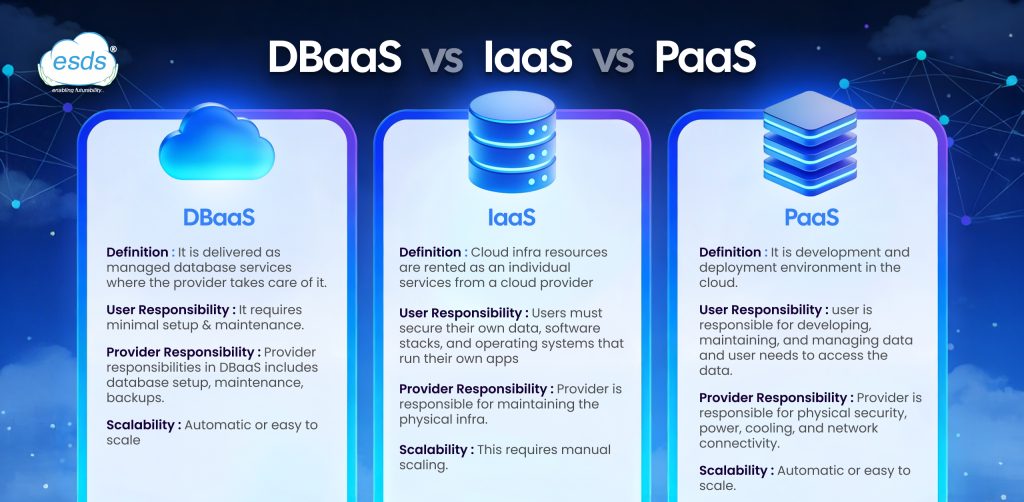
Overview of DBaaS vs IaaS vs PaaS
Explore ESDS Database as a Service
It is a Database as a Service provided by ESDS that helps in the management of databases simply while still achieving the benefits of performance, scalability, and compliance.
It is based on ESDS Sovereign Cloud, which helps organizations manage data in a modern manner without the complexities of traditional infrastructure.
Key Capabilities:
- Real-time transactional workload support
- AI-driven applications support
- Search-intensive and analytics workload support
- Distributed and edge computing support
With ESDS DBaaS, organizations can now use the benefits of cloud-native architecture while still having complete control over data governance and compliance.
Conclusion
Today, most organizations continue to scale digitally, and managing databases efficiently becomes crucial to operational success. Database-as-a-Service (DBaaS) streamlines database management by eliminating infrastructure complexity while enhancing scalability, security, and performance.
With ESDS DBaaS, organizations gain access to a powerful, cloud-native database platform backed by Sovereign Cloud infrastructure. This makes it not only high-performance and flexible but also data residency, compliance and enterprise-grade reliability.

- How AI-Powered Swaraj Security Solution Reduce Cyber Risk Across Enterprise IT? - October 23, 2026
- SWARAJ Sethu: Unified DevSecOps Platform from Code to Production - October 15, 2026
- Real-Time AI Monitoring for Better Model Performance - October 13, 2026