Why Enterprises Need AI-Driven Observability with SWARAJ Garuda and SWARAJ Jatayoo?
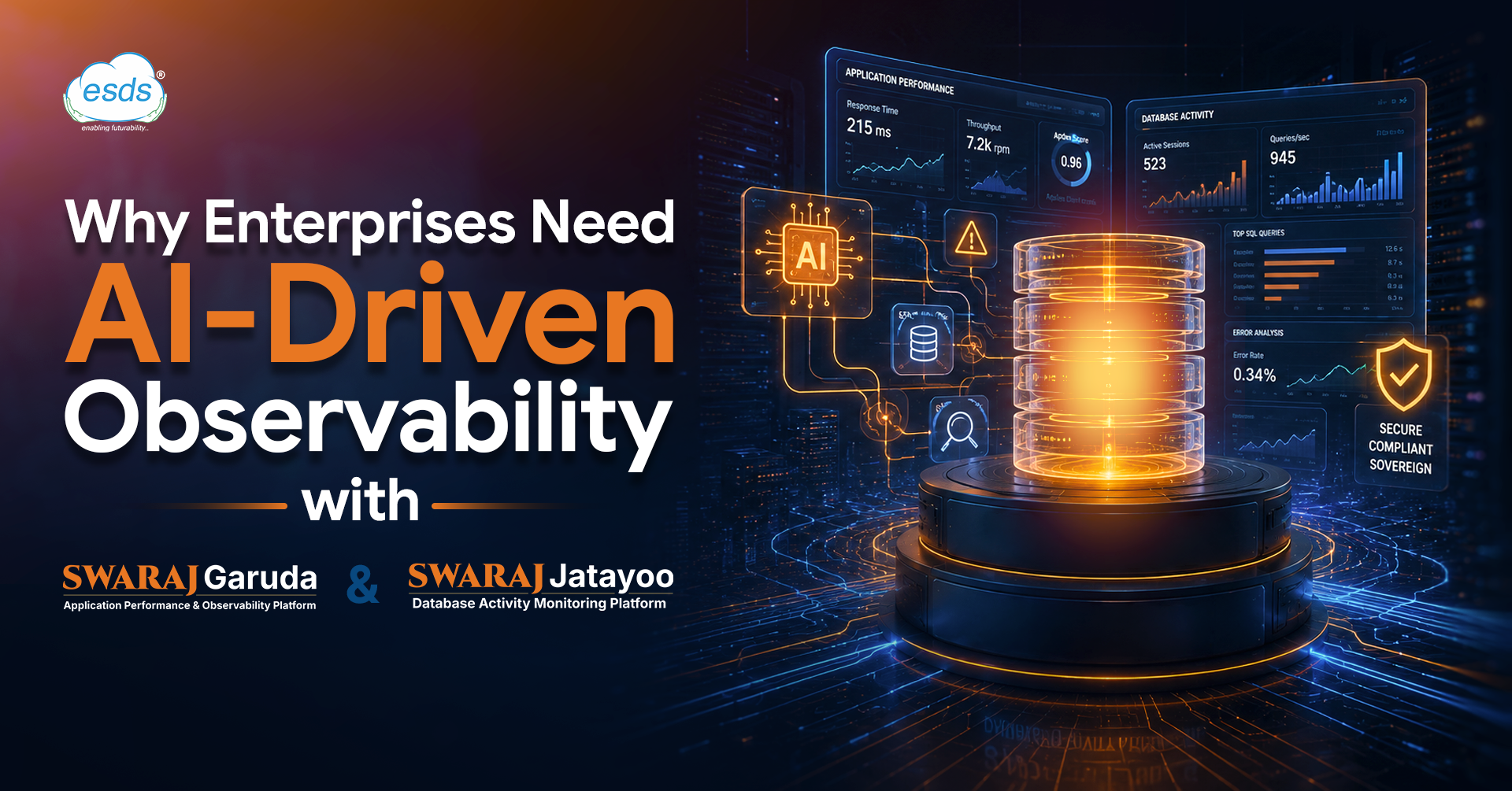
Enterprise IT environments have grown too complex for manual monitoring to keep pace. Applications now span microservices, containers, multiple databases, and hybrid infrastructure, and a single unmonitored gap can turn into downtime, a compliance gap, or a data breach. This is why AI-driven observability has moved from a nice-to-have to an operational necessity for enterprises managing critical workloads.
ESDS addresses this need through two purpose-built platforms: SWARAJ Garuda, an application performance monitoring (APM) and observability platform, and SWARAJ Jatayoo, a database activity monitoring (DAM) platform. Together, they give enterprises visibility across the application layer and the database layer, the two places where performance issues and security incidents most often originate.
The Case for AI-Driven Observability
Traditional monitoring tools were built to report metrics, not to explain them. Teams would receive an alert but still had to manually trace the failure back through logs, services, and infrastructure layers. As environments scale, this reactive approach struggles to keep up.
An AI-driven observability platform for enterprises changes this by correlating telemetry across the stack and pointing teams toward a probable root cause instead of a raw metric. This shortens the time between detecting an issue and resolving it, and it reduces the manual effort involved in cross-referencing dashboards during an incident.
SWARAJ Garuda: Application Performance Monitoring Without Blind Spots
SWARAJ Garuda is built as a unified application performance and observability platform covering nine domains, from application and infrastructure monitoring to logs, containers, and databases, within a single interface. Its feature set includes:
- AI-assisted root cause and anomaly detection, designed to help teams move from an alert to a probable diagnosis rather than starting an investigation from scratch.
- Full-stack visibility across Linux, Windows, and Kubernetes environments, along with support for widely used databases such as PostgreSQL, MySQL, MSSQL, and Oracle.
- OpenTelemetry-native and Prometheus-compatible ingestion, allowing enterprises to work with existing agents and open standards rather than being locked into a single vendor’s instrumentation.
- Flexible deployment options, including on-premises, ESDS Managed Cloud, or air-gapped environments, so telemetry can stay within the deployment boundary an organization’s compliance requirements call for.
- Alerting and incident workflows with composite conditions, de-duplication, and MTTR tracking, along with reporting for SLA and capacity planning needs.
For enterprises evaluating application performance monitoring tools, the value of this approach lies in consolidating what is often a fragmented toolchain; separate tools for APM, infrastructure, logs, and database performance into one observability layer.
SWARAJ Jatayoo: Database Activity Monitoring for a Regulated Landscape
Application-layer visibility alone does not account for what happens inside the database, where sensitive data actually resides. SWARAJ Jatayoo is built specifically for database activity monitoring, tracking queries, logins, and privileged sessions across SQL Server, PostgreSQL, MySQL, Oracle, and MongoDB from a single dashboard.
Its core capabilities include:
- Database Security Posture Management (DSPM), which surfaces exposure points and sensitive data risks on an ongoing basis.
- Real-time query visibility across SQL and MongoDB environments, without requiring database restarts or schema changes.
- AI-driven behavioral analytics intended to help flag anomalous access patterns and privileged-user activity.
- Compliance-oriented reporting aligned with frameworks referenced by RBI, IRDAI, CERT-In, PCI DSS, and ISO 27001, useful for organizations that need audit-ready documentation.
- Air-gapped and on-premises deployment support, relevant for banking, government, defense, and other environments with strict data residency requirements.
This makes SWARAJ Jatayoo relevant for database activity monitoring in BFSI, insurance, healthcare, and government settings, where regulatory reporting and insider-threat visibility are ongoing operational requirements rather than one-time checklist items.
Why Enterprises Need Both Layers Covered
Application performance issues and database security incidents are often connected. A slow query can degrade application performance, while unusual query behavior can also indicate a security concern. Monitoring these layers separately, with disconnected tools and teams, can delay both performance troubleshooting and threat detection.
By deploying an AI-driven APM and DAM platform together, enterprises can bring application-layer observability and database-layer security monitoring into a more coordinated view. This is particularly relevant for organizations operating under India’s regulatory and data residency requirements, where on-premises or air-gapped deployment options can matter as much as the monitoring capability itself.
Getting Started
Enterprises assessing their observability and database security posture can request a proof-of-concept for SWARAJ Garuda or SWARAJ Jatayoo to evaluate how these platforms fit their existing stack and compliance requirements. Reach out to ESDS to schedule a walkthrough tailored to your infrastructure.
Frequently Asked Questions (FAQs):
1. What is AI-driven observability, and how is it different from traditional monitoring?
Traditional monitoring reports metrics and raises alerts, leaving teams to manually trace an issue back through logs and services. AI-driven observability correlates telemetry across the application, infrastructure, and database layers to point teams toward a probable root cause, reducing the manual effort involved in diagnosing an incident.
2. What does SWARAJ Garuda monitor, and which environments does it support?
SWARAJ Garuda covers application performance, infrastructure, logs, containers, and databases from a single platform. It supports Linux, Windows, and Kubernetes environments, along with databases such as PostgreSQL, MySQL, MSSQL, and Oracle, and can be deployed on-premises, on ESDS Managed Cloud, or in air-gapped environments.
3. Why do enterprises need database activity monitoring alongside APM?
Application performance issues and database security incidents are often connected. A slow query can affect application performance, while unusual query behavior can indicate a security concern. Monitoring both layers together helps enterprises correlate performance troubleshooting with threat detection instead of working from disconnected tools.
4. Which industries rely on SWARAJ Jatayoo for database activity monitoring?
SWARAJ Jatayoo is used in BFSI, insurance, government and defense, healthcare, and IT/SaaS/fintech environments, where regulatory reporting and insider-threat visibility are ongoing requirements. It supports compliance-oriented reporting referenced against frameworks such as RBI, IRDAI, CERT-In, PCI DSS, and ISO 27001.
5. Does deploying SWARAJ Jatayoo require downtime or changes to existing databases?
No. SWARAJ Jatayoo is designed for production-safe deployment using lightweight, agent-based monitoring that does not require database restarts, schema modifications, or application changes.

- Why Enterprises Need AI-Driven Observability with SWARAJ Garuda and SWARAJ Jatayoo? - September 9, 2026
- How AI-Driven SIEM Reduces Alert Fatigue at Scale? - July 28, 2026
- Achieving Secure, Reliable Compliance with India’s Data Sovereignty Mandates - November 17, 2025