What is AIOps & How Does it Work in Real-Word IT Environments?
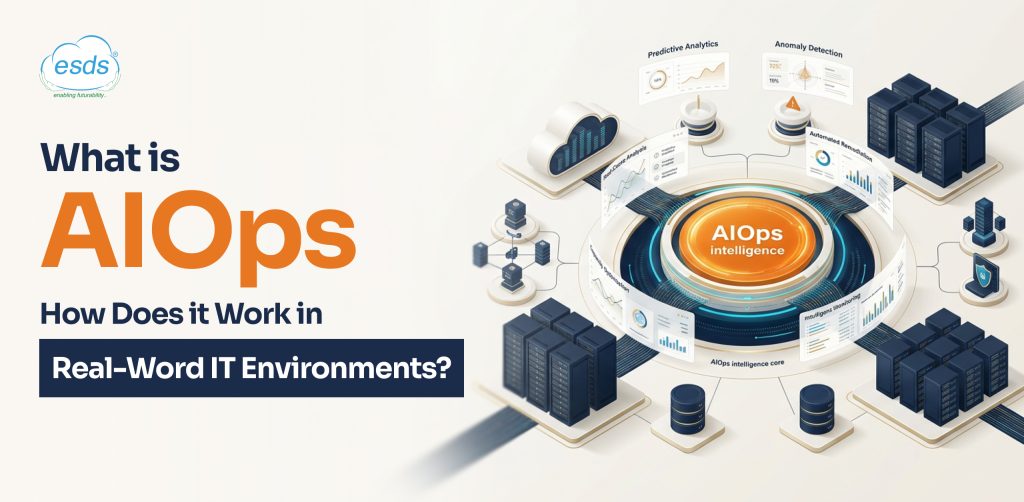
AIOps, or the practical application of automation and artificial intelligence to the IT department’s job, is being adopted by IT teams seeking to shift from a reactive to a proactive approach, decrease downtime, enhance performance, and free up staff to concentrate on more strategic initiatives. AIOps helps manage the immense complexity of today’s technological environments, which encompass hundreds of cloud services, office and data center networks, equipment, and more.
To understand why enterprises are investing in AIOps platforms, it’s important to first understand what AIOps is & how its role has evolved alongside modern AI & cloud environments.
What Is AIOps?
AIOps stands for Artificial Intelligence for IT Operations. When Gartner coined the term around 2017, it referred specifically to applying machine learning and analytics to IT operational data log analysis, anomaly detection, and alert correlation to reduce noise and speed up incident response.
The meaning has since broadened. Today, AIOps covers the full operational layer needed to run AI workloads in production: GPU infrastructure management, ML pipeline orchestration, real-time monitoring, cost tracking, and governance. If your team is training, deploying, and maintaining AI models at any meaningful scale, the tooling and processes around that work not just the models themselves, is what AIOps addresses.
A practical way to think about it: AIOps is to AI workloads what DevOps is to software deployments. It’s the operational discipline that makes production AI repeatable, observable, and governable.
Gap Between AI Investment and AI Outcomes
The numbers here are worth paying attention to. Global enterprise AI spending is significant, but the conversion rate from experimentation to production is poor.
According to a RAND Corporation report based on structured interviews with 65 data scientists and engineers, more than 80% of AI projects fail to reach meaningful production deployment, exactly twice the failure rate of non-AI IT projects.
They’re consistent across research organisations with different methodologies. The common thread isn’t bad models or insufficient compute, it’s operational and organisational readiness.
The specific friction points show up clearly in the data:
- A 2024 State of AI Infrastructure survey found that 74% of companies are dissatisfied with current GPU scheduling tools, and only 15% achieve greater than 85% GPU utilisation during peak periods, meaning the majority are paying for compute they’re not effectively using.
The problems aren’t exotic. They’re the everyday friction that accumulates when AI teams are managing fragmented tools, manual infrastructure processes, and governance workflows that were never designed for AI workloads at scale.
How AIOps Works in IT Conditions?
A well-designed AIOps platform handles several distinct but connected functions across the AI lifecycle: This starts with onboarding compute importing Kubernetes GPU clusters, discovering available capacity, and allocating resources to specific jobs. The objective is to make provisioning repeatable and fast, not a manual process that requires tickets and wait times.
- ML pipeline management: –This covers the MLOps workflow end to end: tracking experiments, managing model versions in a registry, automating training pipelines, and deploying inference services. Templated deployments reduce the configuration work each team would otherwise have to do from scratch for every new project.
- Observability: – Real-time dashboards showing GPU utilisation, memory usage, power consumption, job status, and performance metrics give operators visibility into what’s actually running, and early warning before something fails downstream.
- Access control and audit logging: – multi-tenant environments need clear separation between teams. Role-based access control (RBAC), approval workflows, and audit logs create the accountability layer that compliance teams and regulators require.
- Cost tracking: – GPU-hour showback reports attribute compute consumption to specific teams, projects, or workloads. This matters for internal chargeback, for optimising infrastructure decisions, and for making the AI spend visible to finance and leadership.
The combination of these functions running from a single interface is what separates an AIOps platform from a collection of point solutions.
Where ESDS Swaraj Bodhi (AIOps) Fits?
The global AIOps platform market was valued at $12.4 billion in 2024 and is projected to reach $123.1 billion by 2034 at a CAGR of 25.8% (Market.us). Within India, the broader AI market is growing at roughly 39% CAGR through 2032 (Fortune Business Insights), which means the operational infrastructure to support that growth needs to scale in parallel.
ESDS Swaraj Bodhi (AIOps) is a unified AI operations platform built for enterprise deployments in India. It runs on ESDS’s sovereign cloud infrastructure relevant for organisations that need data residency guarantees, but also supports on-premises and hybrid configurations.
The platform covers the full operational stack: GPU cluster onboarding via Kubernetes, MLOps workflows (experiment tracking, model registry, pipeline automation), real-time dashboards for GPU and workload health, RBAC and audit logging, and GPU-hour showback reports for cost visibility.
Bottom Line
The research is consistent: most enterprise AI initiatives stall not because the models are wrong, but because the operational infrastructure around them is inadequate. Fragmented tooling, poor GPU utilisation, governance gaps, and manual overhead collectively explain why the failure rate for AI in production is twice what it is for conventional IT projects.
AIOps addresses that operational layer directly. For Indian enterprises specifically, where data residency requirements, regulatory traceability, and cost accountability are pressing constraints, a platform built on sovereign infrastructure with governance controls from the ground up is worth evaluating seriously.
FAQs
- How is AIOps different from traditional IT monitoring?
Normal IT monitoring concentrates on gathering information and providing notifications when a certain threshold, such as CPU utilization exceeding, is achieved. This frequently results in a large number of notifications, which causes “alert fatigue.” In order to fully comprehend the nature of a problem, AIOps takes one step further by correlating data from several sources. It can find the one underlying problem and provide a single piece of advice rather than 50 different alerts.
- What are the key capabilities of AIOps platforms?
Three fundamental features form the basis of the majority of AIOps platforms:
- Data aggregation: They consolidate event and performance data from many IT systems.
- AI: They use sophisticated analytics on this data to eliminate noise, find anomalies, spot trends, and forecast future occurrences.
- Automation: They set off automated reactions that speed up the resolution process, such as launching a diagnostic script, creating a thorough ticket, or directing the problem to the appropriate team.

- SWARAJ Sethu: Unified DevSecOps Platform from Code to Production - October 15, 2026
- Real-Time AI Monitoring for Better Model Performance - October 13, 2026
- Top Enterprise Use Cases for GPUaaS in AI & HPC - September 30, 2026