Swaraj Garud: Unified APM & Observability Platform

Your crown jewel application portal is going through some timeout issues. Your DevOps team is frantically working through five dashboards, three cloud platforms, and one Slack channel, which has turned into an actual battleground. All due to an issue which could very well be hidden deep inside 14 telemetry streams.
As much as this scenario looks fictional, let us put some facts in place here. According to Gartner, USD 5,600 on average is what downtime costs an enterprise per minute. The situation remains equally grave for enterprises in India operating with digital-first strategies, with the additional concern for those dealing with regulations in the BFSI, Healthcare and Government segments.
This is where Application Performance Monitoring comes to the rescue. However, modern-day enterprise stacks are becoming increasingly distributed, containerized, multi-cloud, AI-driven and intelligent; traditional APM solutions have been struggling to cope up. To add salt to injury, many foreign APM vendors depend heavily upon lock-in, inconsistent USD billing and telemetry residing on their cloud.
In this blog post, we will demystify APM, understand its relevance and explain how Swaraj Garud India, our AI-powered Application Performance and Observability platform, designed by ESDS, is set to redefine the entire APM landscape for Indian and emerging markets.
What is Application Performance Monitoring (APM)?
“The process of tracking, measuring, and controlling software application performance using specialized tools that gather metrics like response time, error rates, and resource utilization to make sure applications satisfy user expectations and business requirements is known as application performance monitoring, or APM.”
At its core, APM involves collecting performance data from every layer of an application, front-end user interactions, back-end services, databases, infrastructure, and network, and synthesising that data into actionable intelligence.
Modern APM goes far beyond tracking whether an application is “up” or “down”. It answers harder questions:
- Which database query is causing the checkout flow to degrade?
- Has a recent deployment introduced a memory leak in the user-service container?
- Reduce the Business revenue due to poor application performance.
These are the questions that separate reactive firefighting from proactive, intelligence-driven IT operations.
Why APM is no longer Optional?
Application performance isn’t just about the IT environment; it’s about the business impact.
Today, the digital economy has revised the industry IT ecosystem. Consider the following realities: –
- A one-second delay in page response can reduce conversion by up to 7% (Akamai research)
- In financial services, SLA breaches carry regulatory penalties in addition to reputational damage.
For Indian enterprises, the pressure is compounded by the scale of digital adoption. With over 950 million internet users & India’s continued push towards digital public infrastructure, enterprise applications are expected to be resilient, secure, and performant at all times.
APM delivers on five critical dimensions: –
- Improved User Experience: Identifying and resolving performance issues before they affect end users minimises downtime-driven dissatisfaction.
- Operational Efficiency: Automated detection and root-cause analysis reduce mean time to resolution (MTTR).
- Business Agility: Real-time performance data enables faster, evidence-based release decisions in DevOps and CI/CD pipelines.
- Cost-Control: Proactive capacity planning and anomaly detection prevent costly over-provisioning and emergency escalations.
- Data-Driven Decision Making: Performance telemetry provides boardroom-ready reporting on SLAs, capacity trends, and growth projections.
Working of Application Performance Monitoring
A modern APM platform operates through a continuous, multi-stage cycle of data collection, correlation, analysis, and action:
- Data Collection: – Monitoring tools capture data from applications, servers, databases, containers, and networks. This data is sent in real time to a central system.
- Metric Storage and Processing: – The collected data are organised into metrics and stored in a way that allows fast and easy analysis, even at a large scale.
- Issue Detection and Root Cause Analysis: – The system continuously checks for unusual behaviour. When a problem appears, it traces it back to the exact source.
- Alerts and Incident Management: – Relevant alerts are sent to the right team through channels such as email or collaboration tools. Duplicate alerts are reduced, and issue resolution is tracked.
- Reporting and Forecasting: – Reports provide insights on performance, service levels, and future capacity needs, helping both technical teams and leadership make informed decisions.
Five Core Elements of Application Performance Monitoring
Here are the five foundational elements that every mature APM strategy must address: –
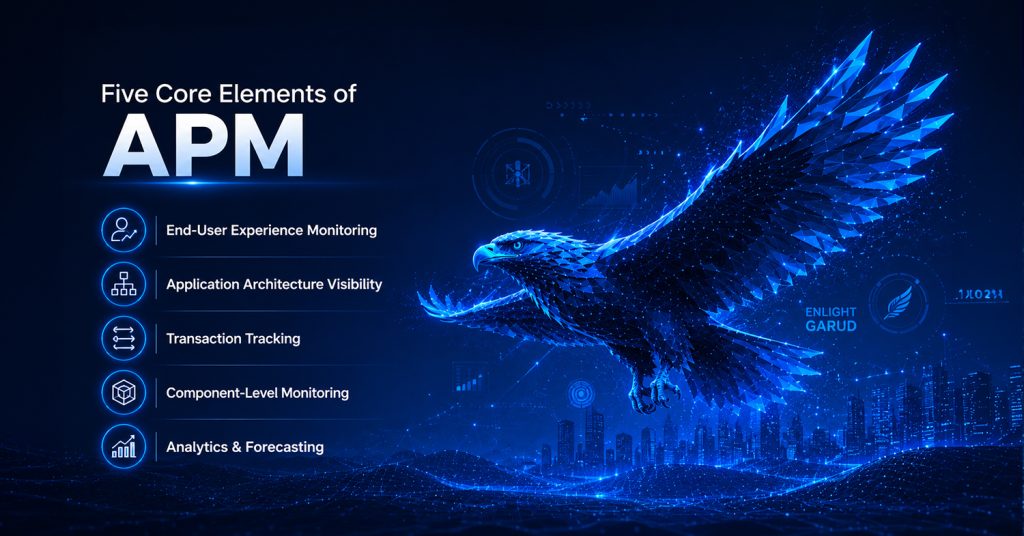
Here are the five foundational elements that every mature APM strategy must address: –
- End-User Experience Monitoring
Track how real users experience your application, including speed and response time. - Application Architecture Visibility
Understand how services, APIs, and databases connect and interact in real time. - Transaction Tracking
Follow each user action, such as login or checkout, across the system to find delays quickly. - Component-Level Monitoring
Keep a close watch on key components like databases, containers, and messaging systems to catch issues early. - Analytics and Forecasting
Turn performance data into insights with trend analysis and future capacity planning. - Analytics and Forecasting
Turn performance data into insights with trend analysis and future capacity planning.
Introducing Swaraj Garud: Unified Application Performance & Observability Platform
Swaraj Garud is India’s Unified Application Performance & Observability Platform with 67+ production features, AI-driven root cause, and complete ecosystem visibility.
- Application and Infrastructure Monitoring
Track applications and systems in real time. View response times, errors, transactions, and server health across Linux, Windows, and virtual machines, all in one place. - AI root cause & anomaly detection
When something breaks, Garud quickly finds the root cause and suggests a fix. It works within your own environment, with no external dependency, and keeps full audit records. - Database Monitoring
Monitor key databases such as PostgreSQL, MySQL, MSSQL, Oracle, and MongoDB. Run queries directly from the platform without switching applications. - Logs, Containers, and Kubernetes
Collect and view logs in one place with sensitive data masked. Monitor containers and Kubernetes workloads with clear visibility across environments. - Security and Compliance
Built-in security features include access control, encryption, and audit logs. Sensitive data is protected at all times, and the system is designed to meet compliance needs. - Alerts and Incident Management
Set smart alerts, reduce duplicate notifications, and route issues to the right teams. Track resolution time and maintain records of every incident. - Easy Integration
Works with your existing tools and systems from day one. Supports standard integrations and both agent-based and agentless monitoring. - Reports and Forecasts
Generate scheduled reports, track service levels, and plan capacity with clear, easy-to-read insights for both teams and leadership. - Custom Dashboards
Create simple dashboards with drag-and-drop tools. Visualise performance, track services, and get a quick view of system health.
Conclusion: APM is the foundation. Sovereignty is the Standard.
The use of Application Performance Monitoring has transcended its traditional role of debugging to provide daily support for digital operations. With a unified and artificial intelligence-powered strategy, businesses can detect problems early, address them quickly, and maintain steady operations.
For companies in India, selecting an APM solution means more than just considering its functionalities. It also includes data control, compliance with national laws, transparency in costs, and less reliance on third-party providers.
Swaraj Garud is designed for Indian settings by Indians, emphasizing openness, data control, and artificial intelligence.
Book a 30-Minute Guided Walkthrough of Swaraj Garud

- What Is Database Activity Monitoring (DAM) and How Does It Work? - July 31, 2026
- When Should You Use GPU-as-a-Service Instead of CPU Cloud? - July 23, 2026
- How Swaraj Cloud Supports India’s Digital Sovereignty? - July 2, 2026