Why Co-operative Banks Need Private Cloud Instead of Traditional Datacentres?
TL;DR (Quick Summary) – Co-operative banks are under pressure from rising cyber risks, growing digital banking demand, and strict RBI regulations. Traditional datacentres no longer provide the agility, uptime, compliance, or security needed for modern financial services. Private Cloud gives co-op banks centralized infrastructure, RBI-aligned compliance, improved uptime, automated DR, cost-efficient OPEX models, and stronger cybersecurity. With ESDS Private Cloud, banks gain scalable, compliant, resilient infrastructure that supports digital transformation and future growth.
Co-operative banks in India serve some of the most financially diverse communities. But while their mandate continues to grow, their underlying technology infrastructure often struggles to keep up. Many still rely on the traditional datacentres or branch level server’s systems that were once sufficient but now present a major roadblock in delivering fast, digital, and compliant financial services.
With rising cybersecurity risks, expanding fintech competition, and increasing compliance obligations from the Reserve Bank of India, the shift towards private cloud for co-op banks is become much important.
Also, “Gartner expects that by 2027, enterprises will use industry cloud platforms to improve 50% of their critical business initiatives”
Limitations of Using Traditional Data Centers
A times of India article highlighted that several co-operative banks operated in a stored manner where each branch managing its own systems resulting in fragmented data, inconsistent customer experience and slower decision making. Today, these challenges have become bigger issues.
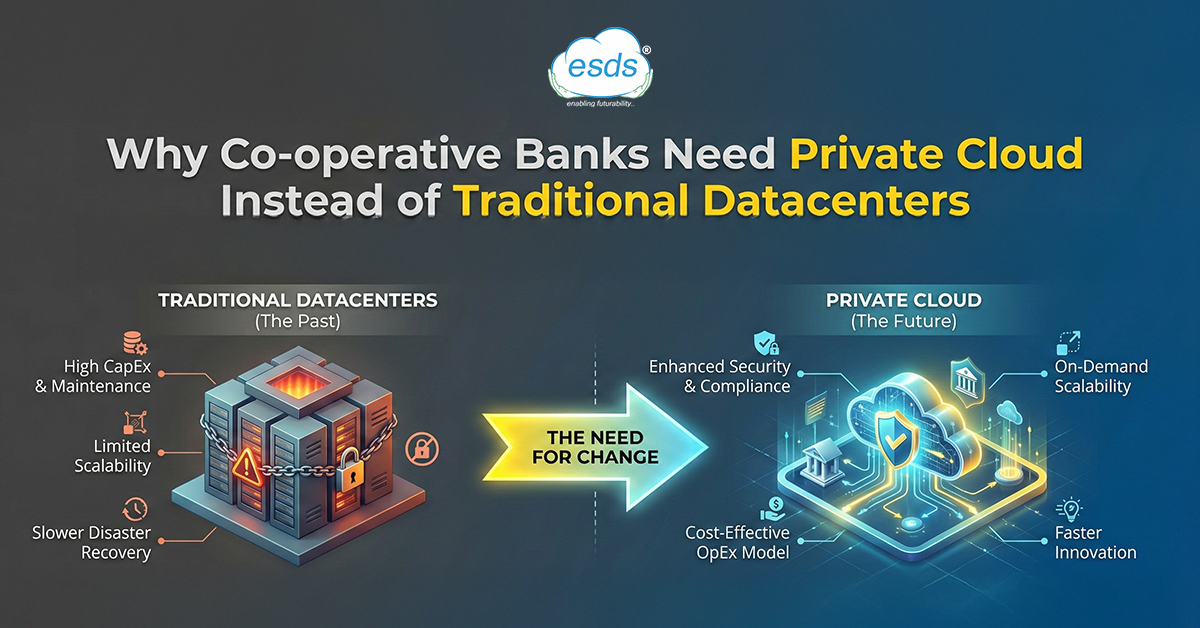
Key weaknesses of legacy data infrastructure include:
- High capital expenditure for hardware upgrades
- Limited scalability when business needs increase
- Often weak disaster recovery and low uptime assurance.
Traditional data centers cannot keep pace with the modern banking ecosystem, especially with digital banking penetration rising.
What a Private Cloud for Co-operative Banks Delivers
A private cloud for co-op banks refers to a cloud environment (either on-premises, dedicated hosted, or managed in a regulated providers data center) i.e. exclusive to a single bank and offers the agility, scalability, automation and cost-efficiencies of cloud computing, but within a security, governance and compliance framework tailored for co-operative institutions.
Key Benefits for co-operative banks: –
- Centralized Infrastructure & Cloud Native Agility
Co-op banks can unify branch systems, eliminate silos, and deploy digital services faster using shared, automated infrastructure.
- Enhanced Uptime & Safety Across Regions
Hosting primary systems in one region and disaster recovery in another ensures operational resilience critical for baking continuity.
Here is the example of Kolhapur District Co-operative Bank (KDCCB) with private cloud services, where hardware procurement was completely managed by ESDS in alignment. The banks infrastructure was built and tested end-to-end by ESDS experts.
- Regulatory Through an RBI-Compliant Cloud
Private cloud platforms embed RBI and BFSI compliance frameworks, ensuring data localization, vendor governance, audit trails, and operational risk controls.
- Cost Efficiency with OPEX-Based IT Investments
Banks avoid large CapEx purchases while gaining access to cloud scalability, automated operations, and infrastructure managed by domain experts.
- Security Posture and Fraud Protection
Secure hosting includes full encryption, identity governance, automated patching, continuous SOC monitoring and AI-driven threat detection to prevent fraud.
Private Cloud vs. Traditional Datacenter for Co-operative Banks
| Feature | Private Cloud | Traditional Datacenter |
| Compliance | Built-in, automated, audit-ready | Manual, slow, risk-prone |
| Cost Model | Subscription OPEX, predictable spend | High upfront CAPEX, variable OPEX |
| Scalability | Instant, elastic scalability | Hardware procurement delays, fixed capacity |
| Security | Integrated, pro-active, AI-driven | Manual, siloed |
| Digital Initiatives | Cloud-native, API-enabled | Slow, integration bottlenecks |
| Disaster Recovery | Automated, geo-redundant solutions | Offsite tape/manual failover |
Why Now is The Time for Co-operative Banks
- Regulatory pressure is increasing: The RBI has intensified its direction on cyber security, outsourcing risk and cloud adoption for banks.
- Digital bank expectations are rising: Customers expect seamless mobile and online services even from smaller banks; branch only models increasingly fall short.
- Cost pressures and competing fintech: Co-operative banks must optimise costs and invest in growth instead of spending on legacy infrastructure.
- Branch-less competition and evolving payments infrastructure: With payment-systems evolving rapidly (and data-localisation mandates tightening), a modern infrastructure backbone is required.
- Technological maturity of cloud services: Today’s cloud platforms (private or dedicated) offer the maturity, security, compliance readiness and operational models that were lacking earlier.
Conclusion: How ESDS private cloud supports Co-op Banks?
ESDS provides private cloud solutions designed to address the core requirements of Indian co-operative banks, including secure infrastructure, operational continuity, and adherence to applicable regulatory guidelines.
Key Capabilities
- Compliance-Ready Infrastructure: Controls and configurations that support alignment with RBI and sector-specific security expectations.
- Managed Cloud Services: Assistance across infrastructure hosting, migration support, and operational monitoring.
- Scalability and Performance Enablement: Cloud environments structured to accommodate growth in digital services and transaction volumes.
- Cost Optimization: Operating expense models that help reduce the need for large, upfront capital investments in IT infrastructure.
- Domain Understanding: Experience working with co-operative banking institutions on cloud adoption and data center modernization initiatives.
These capabilities help banks reduce IT management complexity while maintaining focus on customer and operational priorities.
For co-operative banks seeking modernization, the private cloud provides a structured approach to enhancing service delivery, improving infrastructure resilience, and supporting regulatory readiness.
With private cloud services from ESDS, banks can progress in their digital transformation journey while maintaining required control over data, systems, and security posture.
Frequently Asked Questions (FAQs)
1. Why can’t co-operative banks simply refresh their traditional data centers?
Modernizing physical data centers increases cost and complexity without addressing agility, compliance, and cybersecurity needs.
2. How does a private cloud support regulatory compliance for co-operative banks?
Private cloud environments enable controlled data localization, structured monitoring, and audit-ready reporting for regulatory alignment.
3. Is private cloud security stronger than in-house IT setups?
Private cloud providers typically offer continuous monitoring, timely patching, and advanced threat protection that are difficult to replicate internally.
4. Does ESDS offer support for cloud migration and operations?
ESDS provides managed migration and ongoing infrastructure services to help reduce transition risk and operational burden for banks.
5. Can ESDS help co-operative banks scale digital services cost-effectively?
Yes, ESDS offers consumption-based private cloud models designed to support banking workloads as they grow.

- Proven Ways AI Colocation Transforms Power & Cooling in India - March 23, 2026
- India GPU Cloud 2026: Market Growth, Costs & AI Readiness - March 16, 2026
- Enlight AIOps: A Unified Framework for AI Operations - March 3, 2026


