Private vs Public Cloud: Which Is More Compliant in India?
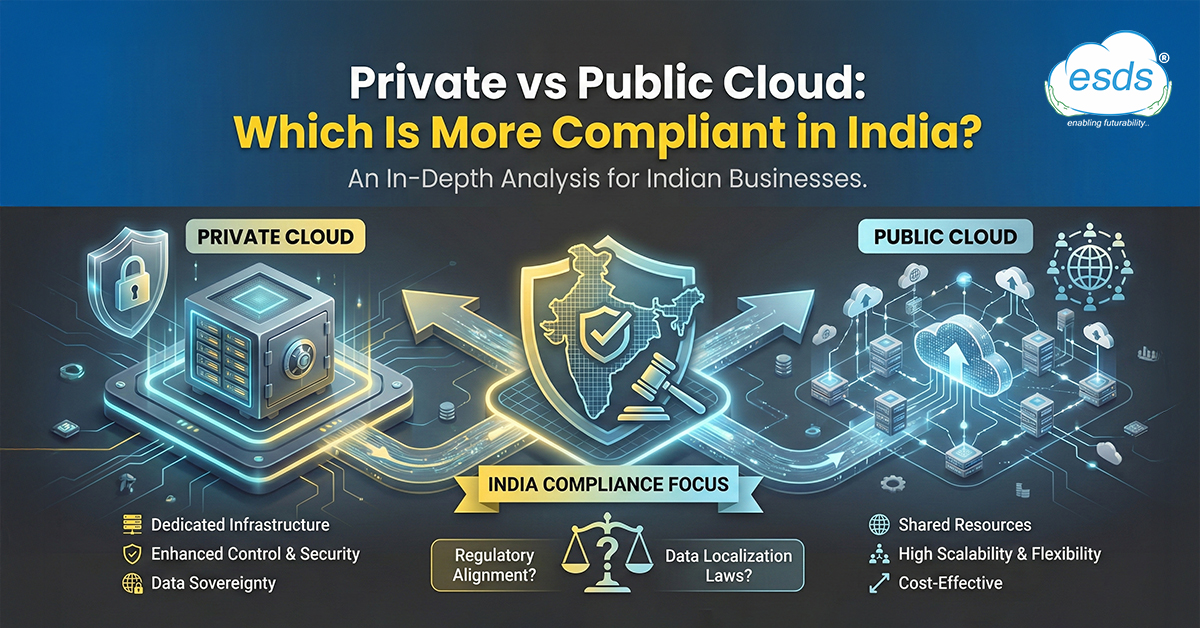
TL;DR (Quick Summary) – Indian businesses face tough regulatory requirements from RBI, IRDAI, CERT-In, and sectoral laws. In the Private vs Public Cloud debate, public cloud offers agility and scale but its shared responsibility model complicates compliance, audit control, and data residency. Private cloud delivers isolation, full visibility, audit-friendly logs, and India-hosted infrastructure—making it the stronger choice for regulated sectors like BFSI, healthcare, and government. ESDS Private Cloud further strengthens compliance through India-based hosting, governance controls, sector-specific frameworks, and audit-ready operations.
Compliance has become important for every Indian business. Whether it’s a bank preparing for an RBI inspection, a healthcare platform handling patient records, or an e-commerce giant managing millions of daily transactions, everyone is asking the same question:
Which cloud keeps us safer, more auditable, and truly compliant — private or public?
It’s not really about good vs bad. It’s about which model reduces risk, simplifies audits, and fits India’s regulatory environment. And when you compare private vs public cloud, especially through the lens of compliance, the differences start to matter much more than they appear on paper.
Public Cloud: Accessible, Capable, and Built for Speed
The public cloud is the “easy start.” You get fast provisioning, elastic scaling, and a huge ecosystem of ready-to-use services. For analytics workloads, app testing, customer-facing apps, and non-sensitive data – it fits beautifully.
Security isn’t the issue here. Major public cloud providers offer strong baseline protections such as:
- Identity and access management
- Encryption at rest and in transit
- DDoS mitigation
- Automated patching
But here’s the twist: the public cloud follows a shared responsibility model. Some controls sit with you, while others remain with the provider. That’s where compliance gets complicated.
- Audit logs may not be fully customizable.
- Physical access policies aren’t yours to define.
- Data location may depend on the provider’s global design.
- Regulatory mappings may vary across regions.
Private Cloud: More Control, More Clarity, and More Compliance Confidence
A private cloud is designed for organizations that treat data governance as a non-negotiable. Here, you control the environment, the policies, the access, and even the hardware layer (depending on the model).
It’s why many Indian enterprises treat the private cloud as more compliance-ready.
1. Physical & Logical Isolation
Your workloads stay segregated — no shared hypervisors and no cross-tenant uncertainty.
2. Full Audit Visibility
Private cloud setups make it easier to present:
- Access logs
- Network flow data
- Change histories
- Patch reports
Auditors love clarity, and private cloud environments offer that without depending on provider dashboards.
3. Clear Data Residency
Indian regulations, especially in BFSI, healthcare, and government expect sensitive data to stay within the country. Private cloud ensures your data remains exactly where you decide.
4. Custom Security Policies
Unlike public cloud’s standardized controls, the private cloud lets you adapt security and access rules based on your internal compliance team’s needs.
Because of this, many organizations prefer private cloud for secure hosting India requirements.
Regulatory Pressure in India Shifts the Decision Further
Indian businesses now operate under sharper regulatory frameworks:
- RBI cybersecurity and IT guidelines
- IRDAI governance norms
- MeitY advisories
- CERT-In directives
- Sectoral data retention rules
- Data protection and data residency expectations
Public cloud can still meet these controls, but it demands more governance effort and more interpretation of shared controls.
Private cloud brings many of those controls directly under your management — reducing ambiguity, friction, and audit fatigue.
For a broader look at India’s data sovereignty and localization expectations, see Data Sovereignty Matters: Secure Your Cloud Now and Why Data Sovereignty Is Important for Indian Enterprises.
Common Compliance Differences in Private vs Public Cloud
Here’s a simple table that explain the difference between public vs private cloud as shown below:
| Factor | Public Cloud | Private Cloud |
| Infrastructure Control | Shared | Dedicated or isolated |
| Data Location Choice | Limited; provider-defined | Fully customizable |
| Audit Readiness | Good, but depends on shared controls | Strong clarity and easier audit trails |
| Custom Security Policies | Provider-restricted | Fully customizable |
| Regulatory Fit | Suitable for general workloads | Preferred for sensitive or regulated workloads |
ESDS Private Cloud: Frameworks Designed for Compliance Operations
ESDS Private Cloud environments are built to support regulated and sensitive workloads across Indian industries, with these configurations designed to address compliance & governance requirements.
- India-Hosted Infrastructure
Workloads run within India-based datacentres that support localization and sector-specific residency expectations.
- Segmentation & Governance
Network segmentation, controlled identity management, and monitored access channels help maintain governance clarity.
- Audit-Ready Framework
Private cloud environments support activity logs, visibility controls, and access histories commonly referenced during compliance reviews.
- Sector-Focused Cloud Frameworks
For industries requiring shared governance models, ESDS supports community cloud environments aligned with relevant guidelines.
- Consistent Operational Controls
Policies around change management, monitoring, and environment control are structured to support regulatory-compliant operations.
These characteristics help organizations operate within a controlled, compliance-aligned cloud environment while maintaining cloud-native flexibility.
Which Cloud Is More Compliant: Private or Public?
Every IT leader in India eventually faces this trade-off: speed versus compliance. Public clouds bring unmatched agility; private clouds bring accountability and control. The right choice often depends on what matters most to your organization.
- Public cloud: better for agility, quick testing, and scalable workloads.
- Private cloud: better for visibility, isolation, and audit transparency.
To explore more, how cloud strategies align with India’s data sovereignty principles, refer to ESDS insights on secure cloud India and compliance frameworks for regulated sectors.
FAQs
1. Which model is better for compliance in India: private or public cloud?
Private cloud generally offers stronger compliance support because it provides isolated infrastructure, controlled access, and clearer audit records.
2. Can public cloud still meet regulatory requirements?
Yes, but it requires more governance work from internal teams. Public cloud’s shared controls sometimes make audits more complex.
3. Why do Indian businesses prefer private cloud for sensitive workloads?
Because private cloud offers workload isolation, custom security policies, data residency control, and high audit visibility — crucial for BFSI, healthcare, and government sectors.
4. What makes a cloud “compliance-ready”?
A compliance-ready cloud typically offers strong access governance, segmented network zones, localized hosting, clear audit logs, and structured monitoring policies.
5. Does ESDS Private Cloud support industry-specific compliance?
Yes. ESDS Private Cloud environments are structured to support Indian regulatory expectations and include sector-focused frameworks such as BFSI community cloud models.

- SWARAJ Sethu: Unified DevSecOps Platform from Code to Production - October 15, 2026
- Real-Time AI Monitoring for Better Model Performance - October 13, 2026
- Top Enterprise Use Cases for GPUaaS in AI & HPC - September 30, 2026