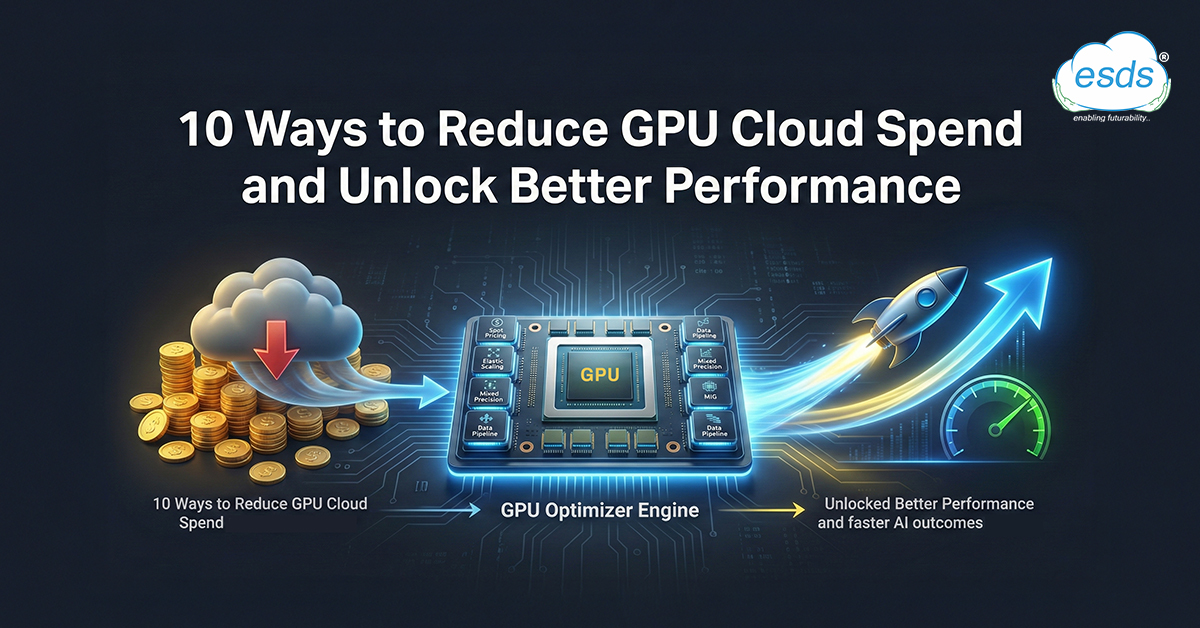
10 Ways to Reduce GPU Cloud Spend and Get Better Performance
TL;DR (Quick Summary) – As AI, ML, and LLM workloads scale, GPU Cloud costs have become a major challenge for enterprises. High-end GPUs are expensive, and inefficient usage, idle clusters, and poor workload planning quickly inflate bills. This blog outlines 10 proven strategies to reduce GPU Cloud spend while improving performance—ranging from right-sizing GPU instances and mixed-precision training to elastic scaling, GPU sharing, and real-time monitoring. It also highlights how sovereign, India-hosted platforms like ESDS GPUaaS help organizations lower costs through transparent pricing, fractional GPUs, and high-performance local infrastructure.
Companies building AI applications or crunching through enormous datasets quickly discover something that rarely gets mentioned in keynote presentations: serious AI needs serious compute. And that kind of compute doesn’t come cheap. High-end GPUs can cost as much as a compact car. We’re talking $9,500 to $14,000 for advanced units, and anywhere between $27,000 and $40,000 for enterprise-grade cards. And that’s before you factor in the rest of the setup: servers, cooling systems, power architecture, and all the supporting infrastructure required to keep those GPUs running at full tilt.
GPU usage is growing across all organizations, with increasing expenses tagging along. This is happening, especially, with AI, ML, LLMs, and deep learning workloads scaling rapidly. Although such rapid growth fuels innovation, it creates one of the single largest operational cost centers today: GPU cloud bills. As a result, engineering and infrastructure teams everywhere have been tasked with finding ways to keep these costs in check without slowing model development or degrading performance.
Below are 10 strategies to reduce GPU cloud spending and improve AI workload performance.
1. Right-Size GPU Instances for Real Workloads
Many teams unintentionally overspend by choosing the highest-tier GPUs for every task, even when the workload does not require such power. The simplest path to savings is matching the workload to the right GPU tier. High-end GPUs such as NVIDIA H100 and A100 should be reserved for extremely large models or pretraining, not routine inference.
By profiling workloads and understanding their actual memory, compute, and throughput requirements, organizations avoid paying for unnecessary performance headroom.
Tips:
- Profile workloads for batch size, memory requirement, and parallelism.
- Use mid-tier GPUs like A10 or L4 for inference-heavy pipelines.
- Scale up only when workloads truly demand more compute.
2. Leverage Spot, Reserved, or Long-Term GPU Pricing
Even the most optimized GPU workloads can become expensive if you rely only on on-demand pricing. A blended pricing strategy can significantly reduce cloud cost overhead.
Pricing Options:
- Spot GPUs: Ideal for non-critical jobs that can resume after interruption.
- Reserved Instances: Best for predictable long-term workloads.
- Hybrid Pricing: Combine spot + reserved + on-demand for maximum flexibility.
Selecting the right pricing model for each workload ensures predictable, long-term savings.
3. Use Elastic GPU Scaling Instead of Always-On Clusters
Always-on GPU clusters continue billing even when idle, silently draining budgets. Elastic scaling provisions GPUs dynamically only when a workload starts, allowing immediate cost reduction without touching performance.
Elastic Scaling Benefits:
- Reduces idle GPU hours
- Lowers power and operational overhead
- Automatically scales clusters up or down
4. Adopt Mixed-Precision Training for Faster Results
Mixed-precision techniques such as FP16, BF16, and INT8 help models train faster using fewer GPU cycles. Modern GPUs are designed to accelerate these operations, allowing engineers to reduce training time and cost.
Why It Saves Costs:
- Faster model convergence
- Reduced training time ? fewer GPU hours billed
- Utilizes Tensor Cores efficiently on A100/H100 architectures
5. Optimize Data Pipelines to Remove Bottlenecks
Many GPU workloads are slower not because the GPU is weak, but because the data pipeline feeds data too slowly. When GPUs wait for data, compute time is wasted and stilled billed.
Pipeline Optimization Tips:
- Replace Python loops with vectorized operations.
- Use accelerated data loaders.
- Cache pre-processed data.
- Pre-process complex transformations offline.
When the data pipeline keeps up, GPU utilization increases and total job runtime reduces.
6. Use Resource Scheduling Tools to Avoid Overlapping GPU Usage
Uncoordinated GPU usage across teams is one of the easiest ways to inflate cloud bills. Scheduling tools help assign compute time intelligently, avoiding contention and duplication.
Recommended Scheduling Practices:
- Allocate quiet hours for heavy training.
- Batch workloads instead of running them ad hoc.
- Assign job priorities.
Resource scheduling directly reduces wasted compute and cuts unnecessary GPU spend.
7. Enable GPU Sharing for Inference and Lightweight ML Workloads
Not every workload needs a full GPU. Many inference tasks run perfectly well on fractional GPU resources.
GPU Sharing Options:
- MIG (Multi-Instance GPU) on A100/H100
- Fractional GPU slices (1/2, 1/4, 1/8)
- Virtualized GPUs for light tasks
8. Monitor GPU Utilization in Real-Time
Visibility is essential for GPU cost optimization. Real-time monitoring tools reveal which workloads underperform, over-consume, or stay idle.
Key Metrics to Track:
- GPU memory consumption
- Compute utilization
- Idle time per job
- Execution duration
- Data throughput bottlenecks
Tools like NVIDIA DCGM and cloud-native dashboards help identify optimization opportunities quickly.
9. Use Containerized Environments to Improve Efficiency
Containerization ensures consistency across runs and reduces troubleshooting time. That means faster execution and lower GPU hours consumed per job.
Benefits of Containers:
- Predictable and reproducible environments
- Lower debugging overhead
- Faster scaling across GPU nodes
- No dependency conflicts
Efficient environments directly reduce unproductive GPU usage.
10. Shift to Sovereign GPUaaS Platforms Built for Cost Efficiency
Public cloud GPU platforms often charge high fees, including egress costs and long queue times due to global demand. Sovereign GPU clouds are emerging as a cost-efficient alternative, especially for India’s enterprises, BFSI institutions, and public sector workloads.
How ESDS GPUaaS Reduces GPU Cloud Spending
ESDS GPU-as-a-Service is a sovereign, India-hosted GPU platform engineered to deliver high-performance AI compute with predictable, transparent pricing. Unlike global clouds, ESDS eliminates additional data transfer costs that are often applied by public cloud platforms.
Key Features of ESDS GPUaaS:
1. Wide Range of GPU Choices
ESDS provides multiple GPU configurations including NVIDIA H100, H200, A100 and AMD GPU options. So, organizations can match their workloads with the right compute level instead of defaulting to high-capacity cards.
2. India-Hosted, Sovereign GPU Cloud
All GPU infrastructure is hosted within ESDS data centers in India, supporting organizations that prefer local environments for regulatory, governance, or data residency considerations.
3. Elastic, On-Demand GPU Scaling
Workloads can scale up or down dynamically. This helps avoid paying for idle resources while still ensuring compute is available when needed.
4. High-Speed Networking Architecture
The GPU nodes run on high-bandwidth, low-latency interconnects, enabling faster training cycles and smoother parallel processing for demanding AI workloads.
5. Fractional GPU Support
Through GPU slicing technologies, organizations can allocate smaller GPU segments for light workloads or inference jobs instead of using a full GPU every time.
Conclusion
Reducing GPU costs does not require sacrificing performance; it requires smarter engineering and choosing the right platform. By implementing the strategies above and leveraging a sovereign, cost-efficient solution like ESDS GPUaaS, organizations can significantly lower GPU spending while accelerating AI outcomes.
Learn how ESDS’ GPUaaS aligns with regulatory, performance, and infrastructure needs across industry workloads.

- Proven Ways AI Colocation Transforms Power & Cooling in India - March 23, 2026
- India GPU Cloud 2026: Market Growth, Costs & AI Readiness - March 16, 2026
- Enlight AIOps: A Unified Framework for AI Operations - March 3, 2026


