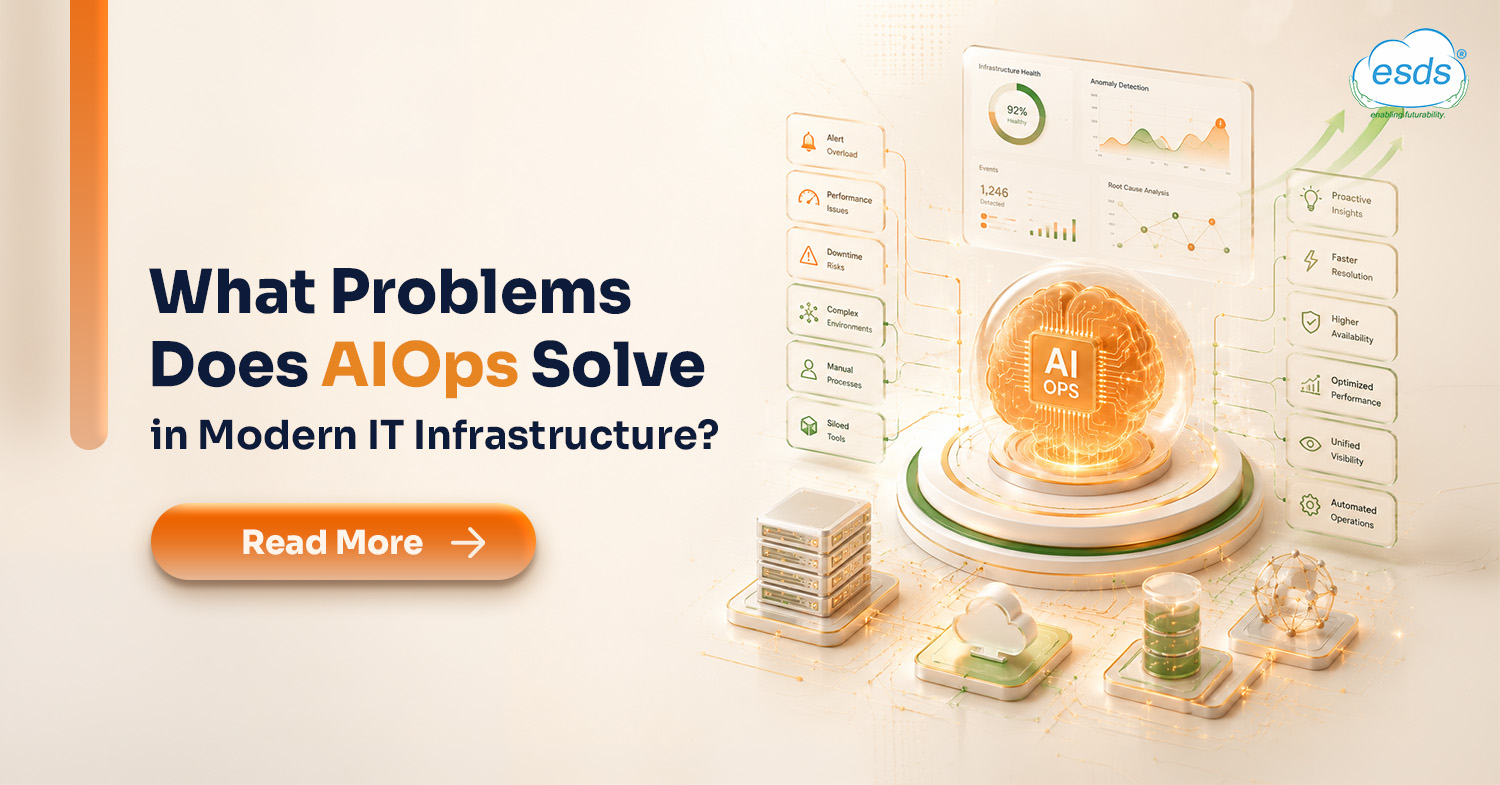
What Problems Does AIOps Solve in Modern IT Infrastructure?
The discussion on AI in the context of the enterprise has changed significantly over the past few years. While a few years ago the discussion was all about developing models and testing out use cases, the real challenge is elsewhere now. How do we operate AI in a reliable, efficient, and scalable manner in modern IT infrastructure?
This has led to a significant gap in the overall scheme of things. While organizations are going all out in developing AI capabilities, the underlying IT infrastructure is still in a state of disarray. This is exactly where AIOps is making a significant impact.
While AIOps is not just another layer in the overall monitoring framework, it is being seen as a fundamental approach to managing the complexity of AI-driven IT infrastructure.
The Complexity Problem in Modern IT Infrastructure
Today’s IT infrastructures are not linear or centralized. Enterprises today are dealing with:
- Hybrid and multi-cloud ecosystems
- Distributed applications and microservices
- GPU-intensive AI workloads
- Multiplicity of tools in monitoring, deployment, etc.
Each of these layers produces large amounts of data in the form of logs, metrics, and events; however, they are often siloed in different systems.
Today’s fragmentation leads to a world where IT teams are spending more time managing tools and infrastructure than they are in enabling innovation. Even simple use cases like identifying performance issues or tracking resource usage can become a time-consuming process.
Where Traditional IT Operations Fall Short
In the past, IT operations were designed around systems that were predictable and stable. But what we are seeing in the case of AI-based systems is much more complex and has become much more complicated in recent times.
Hence, it is not sufficient anymore to just use traditional IT operations and tools. Some of the common challenges faced in such a scenario are: issues not being detected promptly, efficient utilization of resources not being made, and operational costs continuing to escalate. It becomes more and more difficult to maintain consistency between development and production environments.
Given these points, we need a much more efficient and smart way of dealing with IT monitoring, and this is where IT monitoring automation becomes important.
How AIOps Addresses Core Operational Challenges?
AIOps is designed to bring together data, automation, and intelligence into a unified operational framework. Its value lies not in a single feature, but in how it systematically solves multiple interconnected problems.
- From Reactive Monitoring to Intelligent Automation
One of the most prominent changes AIOps brings to the table in terms of monitoring is that, rather than relying on set thresholds and monitoring manually, AIOps platforms constantly analyse system activity in real-time through IT monitoring automation, thus enabling them to:
- Identify anomalies in real-time
- Correlate system events
- Trigger actions without the need for human intervention
This reduces the need to constantly monitor systems manually and enables IT teams to transition from reactive monitoring to proactive monitoring.
- Reducing Fragmentation Across Tools and Systems
One of the biggest operational hurdles in today’s IT environment is tool sprawl. Different teams use different platforms for infrastructure management, monitoring, deployment, and cost management.
AIOps solves this problem by bringing together these different functions into a single system. Rather than having to use different dashboards for different functions, teams gain:
- Centralized visibility
- Integrated workflows
- Unified data
This consolidation of functions can make operations much easier and remove the operational hurdles that often impede AI adoption.
- Improving Resource Utilization and Cost Control
For instance, AI workloads, especially those using GPU resources, require substantial and costly resources. Without AIOps insights, organizations might experience:
- Underutilized resources
- Idle GPU resources
- Unexpected cost escalations
On the other hand, AIOps solutions help in obtaining in-depth insights into resource consumption, which helps in optimizing resources and matching costs with consumption. This is one of the most practical AI IT operations benefits as it affects cost and ROI directly.
- Bridging the Gap Between Experimentation and Production
However, the projects face challenges when they are moved from the testing environment to the live environment. This introduces complexities in the following areas: Monitoring and reliability, Governance and compliance, and Infrastructure consistency
AIOps plays an important role in bridging the gap by providing a standardized approach to workflows. This means that what is successful in the testing environment is also successful in the live environment.
- Enhancing Governance and Operational Control
With an increase in the adoption of AI technologies, the need for accountability and adherence to regulations will also rise. This requires:
- Secure access management for systems and data
- Traceability for all activities performed
- Compliance with regulations
AIOps tools in corporate governance capabilities are at the core of the operation through tools such as role-based access control and traceability.
This guarantees that compliance is not an add-on feature but an integral part of the process.
Understanding AIOps Use Cases in Practice
To grasp the impact of AIOps better, we should consider the following common AIOps use cases across various enterprise infrastructures:
- Infra monitoring and optimization: Ongoing monitoring of infra health and performance
- AI workload orchestration: Optimization of the execution of training and inference workloads
- Cost and resource management: Awareness of cost and resource usage patterns and optimization
- Anomaly detection: Detection of unusual infra behavior before it becomes an infra failure
- Lifecycle management: Maintaining infra consistency from development to deployment
These use cases clearly indicate that AIOps is not limited to a singular function. It is the entirety of the IT and AI lifecycle.
Conclusion
Today’s IT infrastructure is undergoing a fundamental transformation driven by the needs of AI workloads. It is becoming increasingly impractical to deal with the complexities of IT infrastructure management using conventional means.
AIOps is the solution to the key challenges facing IT operations today. It is the fusion of automation, intelligence, and integration into a unified operational approach. It is the key to the future of IT operations.
As the scale of the enterprise’s AI initiatives continues to grow, the question is no longer “Do we need AIOps?” but “How effectively can we use AIOps to build a robust, efficient, and future-proof IT operation?”


About Post Author