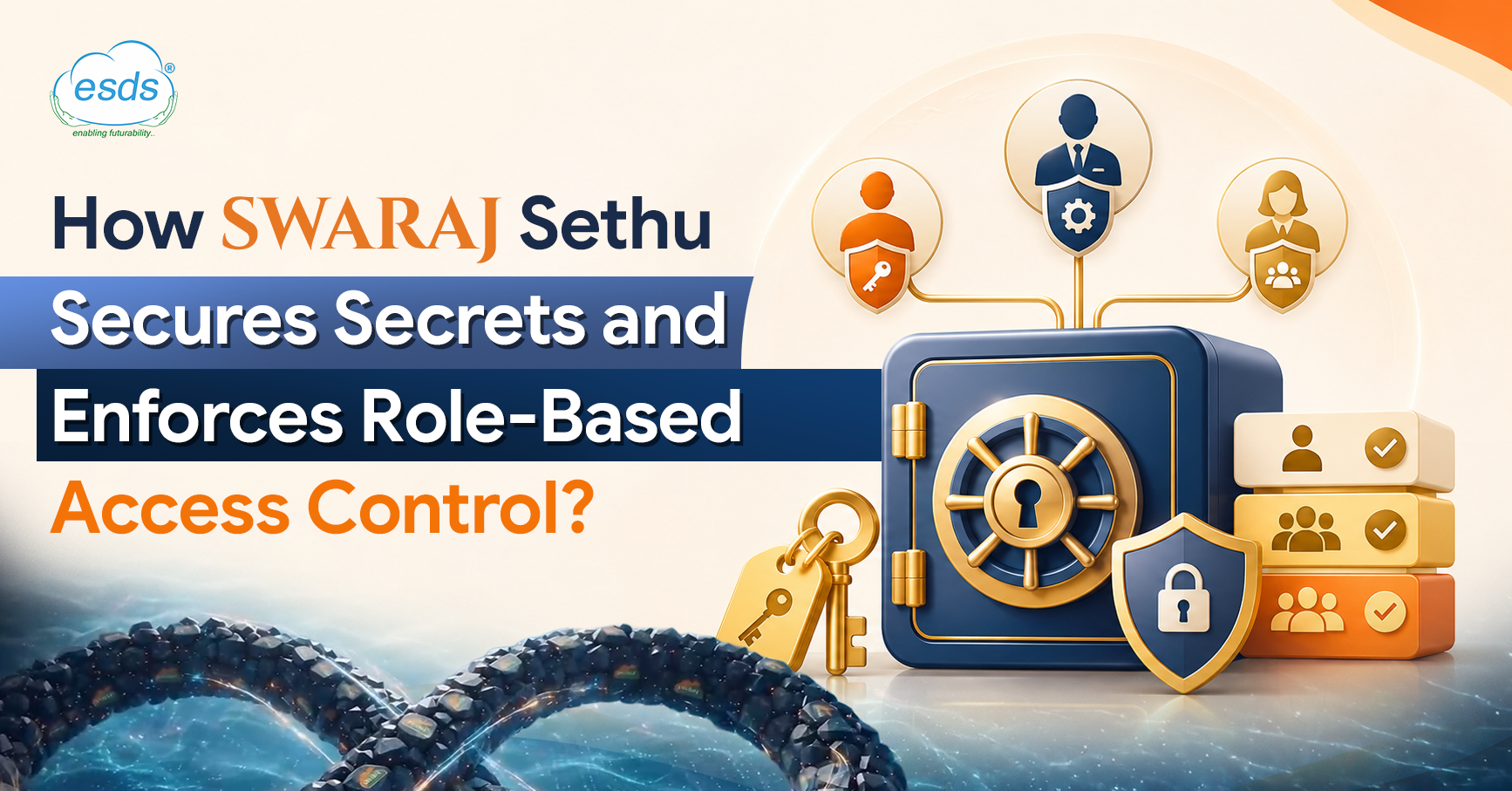
How SWARAJ Sethu Secures Secrets and Enforces Role-Based Access Control?
TL;DR: SWARAJ Sethu strengthens DevSecOps security by combining secrets management and Role-Based Access Control (RBAC) into a unified platform. It protects sensitive credentials through encrypted storage, enforces 88+ granular permissions, and supports multi-factor authentication (MFA). With centralized audit trails, least-privilege access, and secure CI/CD pipelines, SWARAJ Sethu helps enterprises prevent unauthorized access, reduce security risks, and simplify compliance.
Your CI/CD pipeline probably knows more secrets than anyone in your organisation. It holds database passwords, cloud keys, signing certificates and the credentials that reach production clusters. Every tool you add to the delivery chain gets its own copy, and its own idea of who may use them.
The numbers show how far this has spread. GitGuardian’s State of Secrets Sprawl 2026 counted about 28.65 million new hardcoded secrets in public GitHub commits in 2025, up 34% in a year. In one dataset of compromised machines it studied, 59% were CI/CD runners, not personal laptops.
Leaked credentials are rarely the end of the story. Verizon’s 2026 Data Breach Investigations Report found credential abuse somewhere in the attack chain of 39% of breaches.
After gaining access through an unpatched vulnerability, attackers quickly switch to privilege escalation, credential dumping, and password harvesting. They advance laterally, increase privileges, and eventually profit from access through stolen credentials.
What counts as a secret in a delivery pipeline
A secret is any value that proves identity or unlocks access. If it leaks, someone else can act as your system. These are the ones most pipelines handle:
| Secret | Typical use in the pipeline | What a leak exposes |
| API keys and tokens | Calling cloud services, registries and third-party APIs | Whatever the key’s account can do |
| Database credentials | Running migrations and connecting applications | Customer and transaction data |
| Cloud access keys | Provisioning infrastructure as code | Whole environments, and the bill |
| Kubeconfigs and service-account tokens | Deploying to Kubernetes clusters | Production workloads |
| SSH keys | Configuring servers | Direct access to hosts |
| Signing keys and certificates | Signing container images and releases | The power to ship malicious code that looks trusted |
| Infrastructure state files | Recording what IaC has built | Resource secrets, often stored in plain text |
Pipeline secrets are harder to protect than human passwords, for two reasons. Machines use them constantly, so a stolen one blends into normal traffic. They also live a long time:
Pipeline secrets are harder to protect than human passwords, for two reasons. Machines use them constantly, so a stolen one blends into normal traffic. They also live a long time: GitGuardian found that more than 64% of secrets confirmed valid in 2022 still worked in January 2026.
What is RBAC
Role-based access control decides who can do what by bundling permissions into roles, then assigning roles to people and systems. Instead of granting deploy rights to each person one by one, you define a Release Engineer role once and assign it.
Four ideas do most of the work:
- Permission: one action on one kind of resource, such as “run a pipeline” or “read a secret”.
- Role: a named bundle of permissions that matches a job, such as developer, approver or auditor.
- Scope: where a role applies, such as one project, one environment or one tenant. A developer role in a test project should never reach production.
- Least privilege: each person and each machine gets only the permissions its job needs.
RBAC gets harder as an organisation grows. More teams, projects and environments mean more combinations to manage. On a shared platform serving several business units or customers, one wrong scope can expose another tenant’s data.
Why secrets and access control fail together
A secret is only as safe as the list of people and processes that can read or use it. That makes secrets management and RBAC two halves of one control. Strong encryption achieves little if too many roles can decrypt.
In most enterprises, both halves are split across many tools. A typical delivery stack joins source control, CI/CD, a container registry, Kubernetes management, infrastructure as code, configuration management and observability. Each brings its own login, its own permission model and often its own place to keep credentials.
The SWARAJ Sethu makes the same point: every added tool brings more integrations, permissions, upgrades and dependencies to maintain. When an auditor asks who could read the production database password last quarter, a fragmented stack turns the answer into a manual hunt across several systems.
| Scattered toolchain | One governed platform | |
| Where secrets live | A copy in each tool’s settings, variables and config files | One encrypted store, scoped by project |
| Who can access what | A separate role model per tool, drifting apart over time | One permission model across every module |
| Joiners and leavers | Access added and removed tool by tool, with gaps | One identity, one place to change access |
| Audit evidence | Logs in different formats across tools | One audit trail to query |
| Security scanning | Set up project by project, skipped under pressure | Built into every pipeline by default |
How SWARAJ Sethu enforces RBAC
Sethu applies one permission model across all six of its modules: Repository and CI/CD, Kubernetes Operations, Infrastructure and IaC, Configuration Management, Observability and Alerting, and Security and Governance. A permission means the same thing everywhere, so roles don’t drift apart tool by tool.
- 88+ granular permissions, checked at two layers
Sethu defines more than 88 granular permissions, each scoped to a tenant. They are checked where a request arrives and again where the work is done, so access never rests on a single check. Access can be narrowed to a single host or a single Ansible playbook.
No administrator role spans tenants. Screens that work across tenants are limited to platform administrators.
When a request is refused, Sethu’s error message names the missing permission. That helps teams ask for the specific access they need, rather than broad access.
- One identity, with stronger checks for risky actions
Sign-in runs through Keycloak, a widely used open-source identity and access management tool, using OpenID Connect (OIDC), a standard sign-in protocol. A local login is available as a fallback. For Swaraj Cloud customers, users are provisioned automatically and roles stay in sync with the cloud account.
Privileged actions require a second factor, a time-based one-time password (TOTP). Destructive Kubernetes actions, such as draining a node or deleting a pod, also ask the operator to type the resource’s name to confirm.
- Every action leaves a record
Sethu logs every action with the person who took it, the tenant, the resource and the outcome. Kubernetes operations also record the reason given. Retention can be set to match each compliance regime.
That gives auditors one place to answer the questions they always ask: who had access, who used it, and what changed.
Every request pass sign-in, scope and permission checks. Privileged actions add a second factor, and destructive Kubernetes actions a typed confirmation. Each action then lands in the audit trail.
Conclusion
Secrets and access control are not two problems to solve in two tools. A secret is only as safe as the roles that can reach it, and both are only as trustworthy as the record of how they were used.
SWARAJ Sethu brings the three together: encrypted, project-scoped secrets; one permission model across every module; and one audit trail. Teams can run it as SaaS on SWARAJ Cloud, on their own Kubernetes clusters, or fully air-gapped.
To see how Sethu fits your delivery pipeline, explore SWARAJ Sethu or talk our expert today.
Frequently asked questions
What is secrets management in DevSecOps?
It is the practice of storing, scoping, delivering and auditing the credentials that pipelines and applications use. The aim is simple: no secret sits in code, every use is authorised, and every access is recorded.
What is the difference between RBAC and ABAC?
RBAC grants access based on a person’s role, such as developer or auditor. Attribute-based access control (ABAC) decides using attributes, such as location, time or data sensitivity. RBAC is easier to run and audit, so many platforms use it as the base and add attribute checks where needed.
Does SWARAJ Sethu store secrets in plain text?
No. Sethu encrypts secrets using HashiCorp Vault, a widely used secrets manager, and keeps no plaintext secrets in its database or logs.
Can SWARAJ Sethu run without an internet connection?
Yes. The air-gapped option runs on the customer’s own Kubernetes cluster, fully disconnected, with no call home and no telemetry.
How many access permissions does SWARAJ Sethu support?
More than 88 granular RBAC permissions, each scoped to a tenant and applied across all six modules.
Does SWARAJ Sethu support single sign-on and MFA?
Yes. Sign-in runs through Keycloak, an open-source identity tool, using the OpenID Connect standard, with a local login fallback. Privileged actions require TOTP-based multi-factor authentication.


About Post Author