AI Factory Readiness Checklist: 12 Questions to Answer Before You Build
TL;DR: Before building an AI Factory, organisations must assess their readiness across four key areas: AI demand, data availability, infrastructure, and governance. This 12-question checklist uses a 24-point scoring system to evaluate business use cases, data accessibility, GPU requirements, compliance, and skilled resources. Based on the results, businesses can identify readiness gaps, optimise infrastructure investments, and choose between managed GPU services and phased AI Factory deployment. ESDS helps enterprises accelerate AI adoption through scalable GPU cloud solutions, managed infrastructure, and AI-ready data centres, ensuring cost efficiency, security, and operational readiness.
This AI factory readiness checklist asks twelve questions about demand, data, infrastructure and governance. Your organisation is ready to build when it can answer them with evidence rather than intent. Score each question from 0 to 2. Below 12 out of 24, the right next step is a readiness project, not a GPU order.
This article gives you the twelve questions, what a ready answer looks like for each, and how to read the total. It is the step that comes before the build plan in our blog post on how to build an AI factory in India, and after the basics covered in What Is an AI Factory?
What does AI factory readiness mean, and what does it not?
AI factory readiness is narrower than AI maturity. A maturity assessment asks how well an organisation uses AI across the business. Readiness asks one practical question. If capital were committed next quarter to a shared, governed environment for producing AI models, would it be used well? Or would it sit idle while the organisation catches up on data access, approvals and skills?
That framing matters because the expensive failures we see are not failures of ambition. They are GPU clusters ordered before anyone wrote down what they would run, and model pipelines built before compliance agreed what an approval looks like.
Each question is scored 0 for no, 1 for partly or in progress, and 2 for yes with evidence. Evidence means a document, a system or a named person; a plan to have one does not count. One function filling the sheet alone will score it too generously, so the section after the questions splits them by role.
The 12 questions
Demand: what the factory will produce
- Can you name three to five AI use cases, each with a business owner, a data source and an outcome someone is measured on? Ready: a signed-off list. A wish list of twenty ideas scores 0, because nothing has been chosen.
- For each use case, do you know how often the model will be called, how fast it must answer, and how often it must be retrained? Ready: a one-page demand sheet with those three numbers per use case. These numbers decide the training-to-inference split and the hardware class, so guessing them later costs real money.
- Has someone estimated the value of each use case, in rupees or hours saved, and set it against the cost of running it? Ready: at least one use case where the value clearly exceeds the run cost. If no use case passes this test, the factory has no first product.
- Is the data for the first use case accessible today, with an owner who can grant access in days rather than months? Ready: access already granted in a test environment. A request sitting with a committee scores 1 at best.
- Do you know where every dataset involved physically lives, and whether it contains personal data covered by the DPDP Act or a sector regulator? Ready: a data map for the first use cases with personal data classified. Our article on DPDPA and the sovereign cloud explains why location is a design constraint rather than a formality.
- Can you reproduce a dataset exactly as it was on a given date? Ready: versioned storage or snapshots, with lineage captured for the first pipeline. Without this, no model can be audited or rolled back with confidence.
- Have you measured, rather than guessed, how many GPU-hours the first year needs, split between training and inference? Ready: a monthly GPU-hour estimate per use case derived from the demand sheet. Most enterprise factories turn out to be inference-heavy, which changes which GPUs make sense.
- Can your current facilities host GPU density, or have you decided to use a provider instead? Ready: a written facility assessment covering power per rack and cooling, or a provider decision. A plan that assumes the existing server room will cope scores 0; a single dense GPU server can draw as much power as a full rack of ordinary servers.
- Is there one platform for scheduling, model registry, pipelines, and monitoring that every team will share, with a named team to run it? Ready: a platform chosen, managed or self-built, and an owner named. Our article on how ESDS delivers and monitors GPU for enterprise AI shows what the monitoring side of this looks like in practice.
- Does a written AI governance policy say who approves a production model and what the approval checks? Ready: a short policy with a tiered gate (a credit model and an internal assistant should not face the same checks), reviewed by compliance. A policy under drafting scores 1.
- Will GPU costs be allocated to consuming teams from the first month? Readiness: Establish a finance-approved showback model (reporting GPU consumption by team) or chargeback model (billing teams based on their consumption) from the outset. Unmetered compute is often fully consumed but not always used efficiently.
- Do you have, in-house or through a partner, the five roles a factory needs: data engineer, ML engineer, platform engineer, model risk or compliance reviewer, and a product owner? Ready: each role filled by a named person. One person holding all five scores 0, no matter how talented they are.
How to read your score
Add the twelve scores for a total out of 24, then read the band. Three questions override the total. A 0 on question 1 (no chosen use cases), question 4 (no data access) or question 10 (no approval gate) is a stop signal, whatever the rest of the sheet says. Each of those blocks the first model on its own.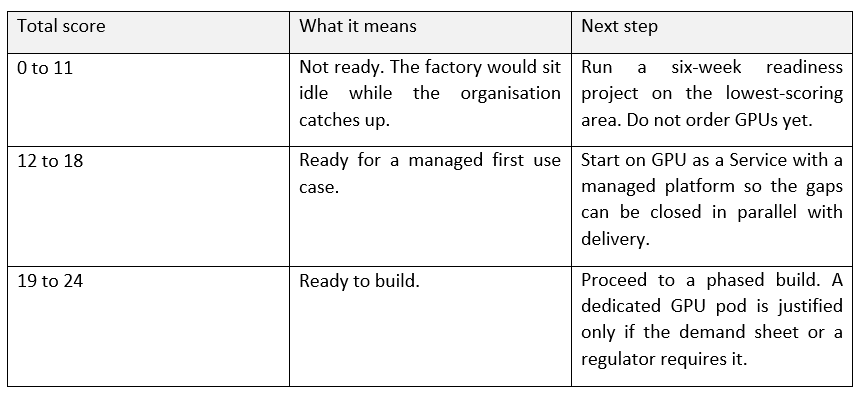
A score in the top band means you can move to the phased plan in our blueprint on how to build an AI factory in India (link once published). The lower bands are where most organisations land on a first pass, and the next two sections show who closes each gap.
Who answers which question
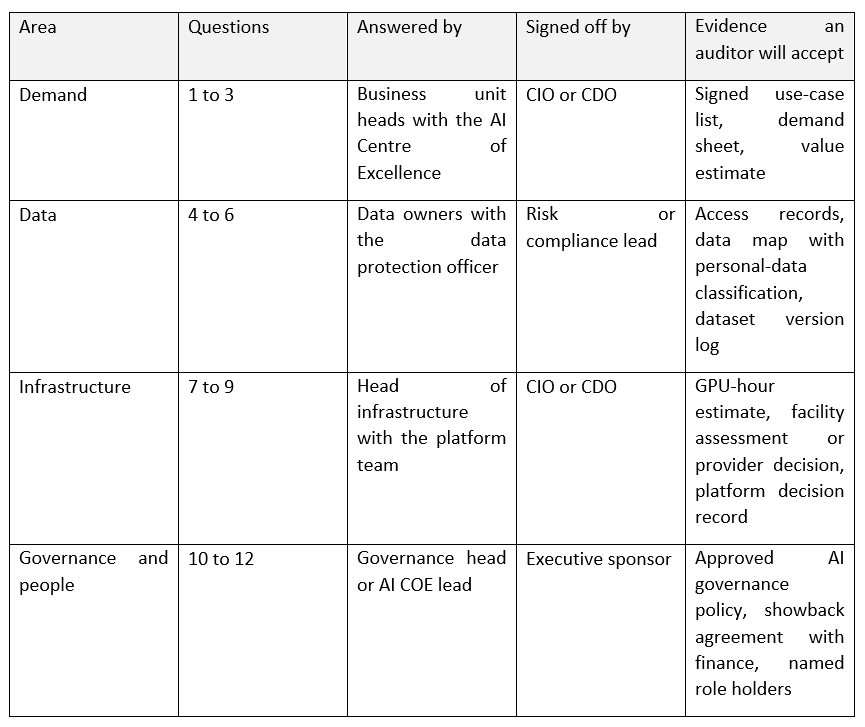
Split the questions by the role that holds the evidence, and have a different role sign each area off. The last column is what an internal auditor will ask to see.
How to use the AI factory readiness checklist inside a Centre of Excellence
Once an AI Centre of Excellence exists, the checklist stops being a one-off and becomes a standing control. Three habits make it useful.
- The COE owns the checklist and its scoring rules, keeps the completed sheets, and runs the review at each build-phase gate and at least twice a year after go-live. The total, and the three stop-signal questions go on the governance forum’s scorecard next to GPU utilisation and lead time to production.
- A question that scores 0 or 1 becomes an action with an owner and a date in the forum’s tracker rather than a remark on a slide. Readiness improves when one person is accountable for each gap.
- The twelve questions broadly correspond to the context, planning, support and operation requirements of ISO/IEC 42001, the management system standard for AI. If certification is on the roadmap, completed checklists are early evidence. If it is not, the mapping still gives internal audit a familiar frame.
ESDS runs its own AI governance through an AI Governance Office and a cross-functional COE forum that owns process standards across the organisation. That is why these questions are phrased the way an internal auditor would ask them.
Frequently asked questions
Is AI factory readiness the same as AI maturity?
No. Maturity describes how widely and how well an organisation uses AI today. Readiness is a narrower, forward-looking check on whether a shared production environment for AI would be used well if it were built next quarter. An organisation can be low on maturity and still ready, provided it has chosen its first use cases and sorted out data access and approvals.
Do we need a data lake before we build an AI factory?
Not necessarily. You need accessible, versioned data for the first two or three use cases, with an owner and a known location. A full enterprise data platform can follow; waiting for one is a common reason factories never start.
Who should fill in an AI factory readiness checklist?
The CIO or CDO chairs it, with the head of infrastructure, the data owner for the first use case and the risk or compliance lead in the same sitting. The risk or compliance lead signs the data and governance areas independently of the people who answered them. The disagreements that surface in that meeting are usually the real readiness gaps.
How often should an AI factory readiness assessment be repeated?
At the end of every build phase, and at least twice a year once the factory is live. Regulators and internal audit tend to ask about the lowest-scoring questions, so the checklist doubles as an audit preparation tool.
Who owns the AI factory readiness score once the build starts?
The AI Centre of Excellence, reporting it to the governance forum alongside utilisation, lead time and cost per inference. Business units own the actions that move their area’s score, and risk or compliance signs off the data and governance areas independently.
Next steps
If your total lands in the middle band, the fastest route to a first production model is managed GPU capacity with the platform run for you. The readiness gaps then close while the first use case ships. ESDS delivers NVIDIA and AMD GPU capacity from Indian data centres as a managed GPU cloud, as dedicated managed infrastructure, or as a captive cluster ESDS helps design, supply and deploy for organisations that must own their own. Community cloud options cover BFSI and government workloads. The GPU as a Service page has the current configurations, and the ESDS team can run this checklist with yours as the first step of a cloud assessment.


About Post Author