30
Sep
Top Enterprise Use Cases for GPUaaS in AI & HPC
TL;DR: This article explains what GPU as a Service (GPUaaS) is and why enterprises are adopting it: high GPU capital costs, procurement lead times, uneven utilisation, and access to the latest architectures. It covers six enterprise use cases (LLM training and fine-tuning, generative AI inference, computer vision, fraud detection, scientific computing/HPC, and recommendation engines), compares... Read More

28
Sep
What Is an AI Factory? Architecture, Benefits & Use Cases
TL;DR: An AI factory is a purpose-built environment that combines data pipelines, GPU compute, MLOps and governance to turn raw data into AI outputs reliably and at scale. This guide covers how it works, its architecture, benefits, industry use cases, and deployment options.An AI factory is a purpose-built computing environment that turns raw data into... Read More
22
Sep
AI-Powered SIEM Trends That Will Shape Security Operations in 2026
AI-powered security information and event management (SIEM) solutions enable practitioners to work far more efficiently and effectively than traditional SIEM solutions, which rely on manual processes to configure data ingestion, triage alerts, and create incident response playbooks, to name a few.Generative AI (GenAI) is used by the most sophisticated of these new SIEM solutions to... Read More
09
Sep
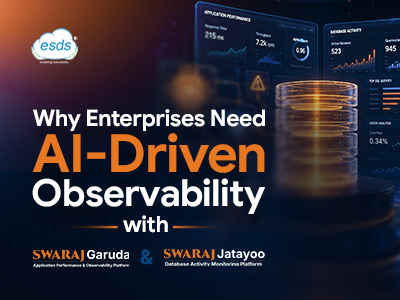
Why Enterprises Need AI-Driven Observability with SWARAJ Garuda and SWARAJ Jatayoo?
Enterprise IT environments have grown too complex for manual monitoring to keep pace. Applications now span microservices, containers, multiple databases, and hybrid infrastructure, and a single unmonitored gap can turn into downtime, a compliance gap, or a data breach. This is why AI-driven observability has moved from a nice-to-have to an operational necessity for enterprises... Read More
31
Jul
What Is Database Activity Monitoring (DAM) and How Does It Work?
By 2026, databases will have evolved to become the main storage place for the most valuable assets – the data itself. With an increasing amount of data produced by businesses, ensuring database security becomes even harder. The current enterprise operates in a hybrid, multi-cloud, and distributed environment, which makes standard security approaches not enough for... Read More

28
Jul
How AI-Driven SIEM Reduces Alert Fatigue at Scale?
Every morning, security analysts across the world open their dashboards and face the same impossible task. Thousands of alerts. A handful of genuine threats are buried somewhere inside. And no reliable way to tell the difference quickly. According to IBM’s Cost of a Data Breach Report, the average enterprise SOC receives over 10,000 security alerts... Read More
23
Jul
When Should You Use GPU-as-a-Service Instead of CPU Cloud?
Every infrastructure decision eventually comes down to one question: is this workload better suited to a CPU or a GPU? As AI, machine learning, and data-heavy applications become standard parts of business operations, that question directly affects your training time, inference costs, and ability to ship on schedule. This guide breaks down exactly when GPU-as-a-Service... Read More
09
Jul
Data Sovereignty in India 2026: The Enterprise Playbook
TL;DR (Quick Summary): Data sovereignty means Indian courts/regulators govern the data and control its encryption keys – not just where it’s physically stored (that’s residency/localization, and even India-hosted data can be pulled by a foreign court under laws like the US CLOUD Act). Indian enterprises must map data across overlapping regulators (DPDP, RBI, SEBI, IRDAI,... Read More

02
Jul
How Swaraj Cloud Supports India’s Digital Sovereignty?
If you’re running a business in a regulated sector in India, picking a cloud provider isn’t just a technology decision anymore; it’s a compliance decision too. Swaraj Cloud, developed by ESDS, is built on Indian-owned infrastructure and operated within India. It’s worth understanding why this category is getting so much attention right now. According to... Read More
29
Jun
GPU Infra for AI Workloads: Challenges Slowing Down Enterprise AI
While the pace of AI technology adoption is accelerating across industries, many organizations are experiencing friction much earlier than anticipated. It is not due to the quality of the models being built or the data being used. It is because the infrastructure is having trouble keeping up. While the GPU environment may have looked robust... Read More